Current Issue

2026 Vol. 40, No. 2

2026, 40(2): 1-2.
Abstract:
Modern Traffic Engineering
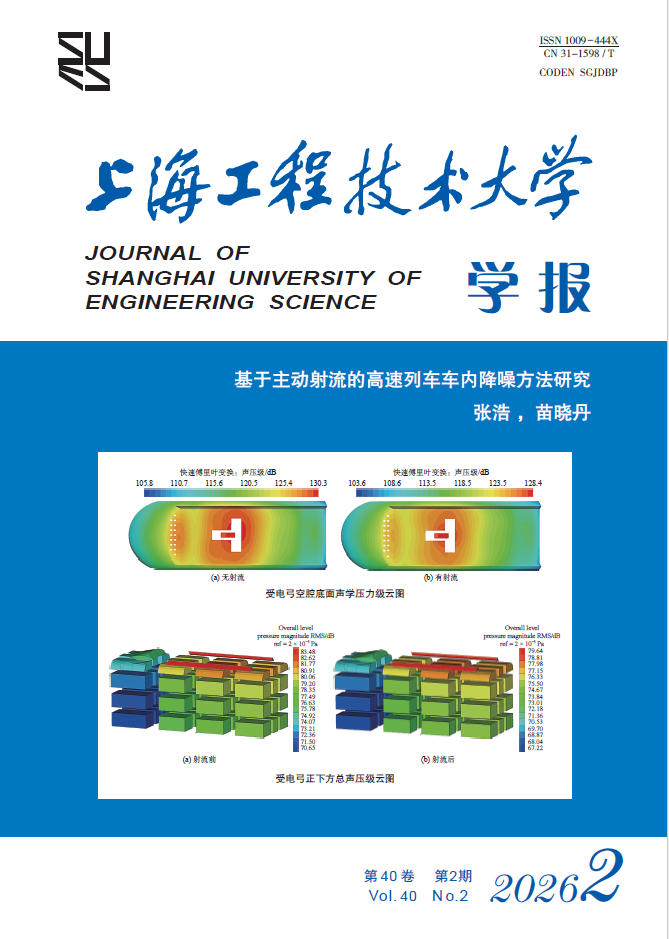
Research on noise reduction method in high-speed train carriages based on active jet flow
ZHANG Hao, MIAO Xiaodan
2026, 40(2): 107-113. doi: 10.12299/jsues.25-0103
Abstract:
To address the aerodynamic noise induced by higher speeds, the acoustic pressure in the pantograph region and the resulting interior noise of a 400 km/h high-speed train were investigated. The noise reduction effect of active jet flow on the pantograph cabin was explored. The results show that the acoustic pressure in the pantograph region exhibits distinct high-frequency characteristics, with dominant frequencies distributed between 1000 and 1600 Hz, primarily concentrated around insulators and the upstream cavity. After the application of active jet control, the acoustic pressure was significantly reduced in the frequency range of 20 – 2500 Hz. Power input to the pantograph cabin acoustic cavities originates primarily from adjacent cavities and panels, with frequencies distributed between 20 and 1600 Hz. A frequency jump occurs at 1250 Hz due to the coincidence frequency effect in single-layer panels. The interior noise directly below the pantograph was reduced by 3.7 dB, with the most significant reduction of 3.5 dB observed in the acoustic cavity most sensitive to human hearing. The front passenger cabin cavity achieved an average noise reduction of 3.3 dB. These findings provide references for future interior noise reduction in high-speed trains.
NDWCM-PSO based energy management strategy for passive sensing
FAN Jinghua, HUO Fengfeng, REN Jianliang, GAO Ang, PENG Lele, ZHOU Xin
2026, 40(2): 114-120. doi: 10.12299/jsues.24-0321
Abstract:
To ensure that train passive sensors achieve long-term uninterrupted collection and transmission of state data under complex operating conditions, a passive sensing energy management strategy based on an improved particle swarm optimization (PSO) algorithm was proposed. Firstly, the passive sensing energy conversion relationship was analyzed, analytical equations among energy characteristic parameters, operating modes, and train operating conditions were obtained, and a passive sensing energy model was constructed. Secondly, to address the deficiency that the original PSO algorithm is prone to falling into a local optimum in the later stage of solving complex problems, a nonlinear decreasing weights and chaotic mapping - particle swarm optimization (NDWCM-PSO) was proposed. By establishing a solution model based on the NDWCM-PSO algorithm, energy matching among system energy characteristic parameters, operating modes, and trains operating conditions was realized, and passive sensing energy management was completed. Finally, the effectiveness of the algorithm was verified by building a passive experimental system for train traction motor bearing condition. The results indicate that under speeds of 20 km/h and 80 km/h, the system realizes long-term uninterrupted data acquisition and transmission functions with a sampling frequency of 10 kHz and a sampling interval of 60 s.
Optimization of subway train operation plan considering online coupling and decoupling scenarios
CHEN Guanwen, PAN Hanchuan
2026, 40(2): 121-127. doi: 10.12299/jsues.24-0282
Abstract:
To address the uneven spatial and temporal distribution of passenger flow in urban rail transit, the optimization problem of train operation plans for full-length and short-turn routes under online coupling/decoupling scenarios was investigated. For a rail line with lower passenger demand at both ends and higher demand in the middle, the minimization of passenger waiting time and train travel kilometers was set as the objective. The departure frequency, train composition sizes for full-length and short-turn routes, and the selection of short-turn stations were defined as decision variables. Considering constraints such as train size, load factor, and passenger flow, an integer programming optimization model for the train operation plan was formulated. With a metro line in a certain city as a case study, the model was solved using a two-stage solution algorithm and the CPLEX solver. The results indicate that passenger waiting time and train travel kilometers are reduced by 20.83% and 30.09%, respectively, which significantly improves the matching degree between train capacity and passenger demand.
Risk study of subway passenger compartment door switching system combining STPA and DEMATEL-ISM
XU Yanqi, ZHU Haiyan
2026, 40(2): 128-134. doi: 10.12299/jsues.24-0215
Abstract:
Accurate risk identification and analysis are the foundation for ensuring subway operation safety and an effective way to improve it. The passenger compartment door opening and closing system was taken as the research object, a risk analysis model combining system theoretic process analysis (STPA) and decision-making trial and evaluation laboratory and interpretive structural modeling (DEMATEL-ISM) was constructed to complete the systematic identification and importance analysis of risk factors, and to identify the risk transmission paths that may cause system-level hazards. Based on this analysis, risk prevention suggestions were proposed. The results indicate that electronic door control unit (EDCU) core processor failure and EDCU internal power module damage are key causal factors, while abnormal operation of the screw, motor, and nut components and improper operation by the driver are key result factors. These factors all involve multiple risk transmission paths that may lead to system-level hazards and should be given close attention.
Ship wake segmentation network based on attention mechanism
LUO Yushi, ZHOU Zhifeng, REN Pulin
2026, 40(2): 135-142. doi: 10.12299/jsues.24-0167
Abstract:
Aiming at the problem that traditional deep learning semantic segmentation networks are difficult to achieve high-precision segmentation of ship wakes, a VGG-UNet semantic segmentation network model based on the channel prior convolutional attention (CPCA) was proposed. First, a ship wake dataset of optical remote sensing images was constructed through a literature review and visual interpretation, and the dataset was expanded through data augmentation techniques. Second, the U-Net network architecture was improved by incorporating a visual geometry group (VGG) backbone for feature extraction in the encoder section, integrating the CPCA into the skip connection part of the VGG-UNet model, and adopting transfer learning strategies to enhance feature acquisition capabilities. Finally, the improved VGG-UNet was trained, and comparison experiments and ablation experiments were conducted. The experimental results demonstrate that the improved network model achieves 87.68%, 92.67%, and 91.58% on the three evaluation metrics of mean intersection over union Im, mean recall Rm and mean pixel accuracy Pm, respectively, and all its evaluation metrics are superior to those of the U-Net, VGG-UNet, and Res-UNet network models. The proposed network model exhibits higher segmentation accuracy, providing a new approach for more complete segmentation of ship wakes.
Computer Technology and Manufacturing Engineering
Automatic docking and system simulation of compartments based on distributed detection
XU Panping, ZHANG Liqiang, YANG Tong, WU Nan, LIU Gang
2026, 40(2): 143-151. doi: 10.12299/jsues.24-0237
Abstract:
With the rapid development of China's aerospace industry, high-precision and high-efficiency assembly docking technology for spacecraft compartments is an urgent problem to be solved. To meet the assembly requirements for compartment attitude docking, a compartment pose detection algorithm and docking strategy based on distributed binocular camera pose detection were proposed. Considering the occlusion of feature measurement points in practical engineering, real-time online detection of the compartment pose was achieved through transfer targets and marking grids, combined with the six-degrees-of-freedom pose calculation of the compartment. Additionally, a docking simulation model for the compartment was established using the D-H method. Within a Simscape-Simulink simulation environment, a docking simulation system comprising mechanical and control system modules was designed, and a six-degree-of-freedom joint debugging experiment was conducted. The results show that the detection algorithm and docking strategy improve docking efficiency while meeting precision requirements, demonstrating certain feasibility in practical engineering applications.
Structral design and stiffness modeling analysis of linear drive flexible joint based on magneto-variable stiffness
ZHOU Yuxuan, CHEN Saixuan, SUN Yixia, ZHU Zina, CUI Guohua
2026, 40(2): 152-159. doi: 10.12299/jsues.24-0384
Abstract:
To address the problems of limited environmental adaptability of rigid manipulators, limited force output capability of flexible manipulators, and slow response and discontinuous stiffness variation of traditional variable stiffness technologies, a cable-driven pure flexible joint and a rigid-flexible coupling joint based on magnetorheological variable stiffness were designed. First, a magnetorheological elastomer model based on an inclined chain was established, and the factors affecting its strength were analyzed. Then, a cable-driven pure flexible joint with a magnetorheological elastomer as the central body was designed. Its stiffness model was established by simplifying it to a cantilever beam, and the accuracy was verified. The experimental results show that the joint stiffness is increased by 33% at a magnetic field strength of 40 mT. Next, a rigid-flexible coupling joint was designed. Based on the principle of virtual work, a torque model of the joint was established, from which the joint stiffness model was derived, and simulations and experiments were conducted. The results show that the stiffness is increased by 46.4% at a current of 2 A. Comparative results indicate that the rigid-flexible coupling joint has a broader range of stiffness variation.
Recognition of growth characteristics during recovery of seafood mushroom based on machine vision
SHEN Jiali, YANG Shuzhen, DU Wanhe, ZHANG Dongjian, LI Peichao
2026, 40(2): 160-166. doi: 10.12299/jsues.24-0286
Abstract:
In the actual mushroom house environment, the interference from background and blue light has a significant impact on the identification effect of seafood mushroom mycelium in the recovery period. Therefore, an intelligent computation method based on improved threshold processing using machine vision was proposed. To address the above problems, image noise was first removed by Gaussian smoothing, and then the background-free mycelium image was extracted by top-hat adaptive binarization method (TH-ATB) combined with maximum area contour detection. Subsequently, the improved automatic white balance algorithm (IAWB-GWPR) is integrated with contrast limited adaptive histogram equalization (CLAHE) to address blue light interference. Finally, the gray histogram is used to calculate mycelium density and coverage, while two-dimensional Gaussian fitting assesses distribution uniformity. Experimental results demonstrate that the proposed algorithm achieves a coefficient of determination of 0.94 under blue light conditions, improving by 0.15, 0.14, and 0.35 compared to the no treatment, IAWB-GWPR, and CLAHE methods, respectively. The interval ratios for density and coverage are 83.64% and 88.98%, with relative deviations remaining within acceptable limits.
Research on reliability evaluation method for sensor signals in data reinjection system
HU Mingchen, WU Changshui
2026, 40(2): 167-173. doi: 10.12299/jsues.24-0383
Abstract:
The test system for an intelligent driving system is a research priority of intelligent driving, where the perception layer sensor signal used for reinjection must be reliable and effective. To address the insufficient objectivity of horizontal comparison using a single error index, a reliability evaluation method for sensor signal reinjection based on quantification of margins and uncertainties (QMU) was proposed. Based on the core principle of QMU, a reliability evaluation pathway was first established by incorporating evaluation thresholds. Subsequently, a comprehensive fuzzy evaluation system and process, integrating the order relation method (G1) and an uncertainty scale factor, were developed for sensors in the data reinjection system, from which the test results were derived. Finally, a test scenario was built in the simulation software, and the reinjection signals of the millimeter-wave radar and LiDAR received by the domain controller were evaluated. The results show that for the measured data, the characteristic values of the LiDAR maximum elevation error, XY-plane error, X-plane error and Y-plane error are 2.89, 0.45, 1.063 and 0.65, respectively, with a comprehensive evaluation result of 2.82. The characteristic values of the millimeter-wave radar for ranging, angle measurement and velocity measurement are 2.1429, 1.5306 and 1.1705. The comprehensive evaluation result obtained by the proposed method is 1.467. This method can overcome the limitations of horizontal comparison of a single index, and realize the in-depth evaluation and objective quantification of the sensor reinjection system.
Fault identification of piezoelectric sensor based on 1DCNN-BiLSTM-cross-attention
CHEN Yongbo, ZHANG Ting
2026, 40(2): 174-182. doi: 10.12299/jsues.24-0392
Abstract:
To address the fault identification problem of macro fiber composite (MFC) piezoelectric sensors, a fault identification method based on a one-dimensional convolutional neural network (1DCNN) and a bidirectional long short-term memory (BiLSTM) network integrated with a cross-attention mechanism was proposed. Different types of sensor faults were experimentally simulated to obtain fault data. The data were processed by fast Fourier transform and by variational mode decomposition with parameters optimized by a particle swarm optimization algorithm, respectively, and the resulting features were combined to obtain mixed time-frequency domain data. Subsequently, fault identification was performed on the data using the 1DCNN-BiLSTM-cross-attention (1DCBCA) model, and an accuracy of 99.4% was obtained. Compared with other models, the proposed model yields superior identification accuracy and is highly applicable to the fault identification of MFC piezoelectric sensors.
Research on improvement mechanism of cross-border e-commerce sales performance under COSMO algorithm paradigm
ZHA Yuexia, LYU Jie
2026, 40(2): 183-188. doi: 10.12299/jsues.26-0107
Abstract:
Addressing the problems of inadequate adaptation of traditional marketing theories and unclear performance transmission mechanisms in Amazon cross-border e-commerce under the iteration of the common sense knowledge generation and serving system (COSMO) intelligent algorithm, performance improvement paths were empirically examined using Amazon US enterprises as samples, based on information processing, relationship marketing and algorithm empowerment theories. The results indicate that content marketing investment and brand relationship construction significantly positively influence organic traffic, new product sales speed, and long-term sales performance; organic traffic and new product sales speed play a chain mediating role, while customer lifetime value acts as a key mediator; and the COSMO algorithm has a significant positive moderating effect on core transmission paths. It is revealed that the COSMO algorithm reshapes the platform traffic allocation logic, relationship-oriented content and brand operations are the core path for long-term growth, and customer lifetime value is the key mediator for performance transformation. These results provide new insights into the marketing improvement mechanism of cross-border e-commerce under the COSMO algorithm, theoretical and practical references for intelligent operation and sustainable growth of enterprises.
Intelligent Engineering and Collaborative Design
Dynamic response prediction method of long-span road-rail suspension bridge based on LSTM
LIU Dawei, LI Zaiwei
2026, 40(2): 189-195. doi: 10.12299/jsues.24-0311
Abstract:
For long-span road-rail suspension bridge, it is often difficult to establish a mapping relationship between loads and response due to the huge and mixed dynamic data output from the structural health monitoring system, thus hindering the adoption of reasonable maintenance strategies. A specific long-span road-rail suspension bridge was selected as the research subject. The dynamic response data from the health monitoring system were analyzed in detail, and the prediction performance of vibration responses (acceleration and deflection) under various loading factors (highway vehicles, railway vehicles, temperature, and wind speed) was investigated using the long short-term memory (LSTM) neural network method. The results indicate that the LSTM network can effectively predict the dynamic response of such bridges. Specifically, deflection can be predicted with only temperature load as input after slightly more than ten iterations, whereas vertical and lateral vibration acceleration require simultaneous inputs of temperature, wind, highway and railway loads and can be accurately predicted after approximately 400 iterations.
Research on status evaluation method of long-span high-speed railway extradosed bridges based onAHP method
LIN Jiazhen, SONG Yumin, WANG Xudong, GUO Shuling
2026, 40(2): 196-201. doi: 10.12299/jsues.24-0288
Abstract:
With the surge in demand for health monitoring of long-span railway bridges, an urgent need exists for an evaluation method capable of reflecting the actual service status of bridges. A high-speed railway extradosed bridge was selected as the case study. Based on its health monitoring system and measured data, combined with domestic and foreign bridge evaluation methods, the analytic hierarchy process (AHP) was adopted to quantify the relative influence weights of critical structural components on overall performance. Consequently, a comprehensive evaluation of the bridge’s service status was conducted. A scoring formula for the bridge structural state was constructed, and actual monitoring data were analyzed to validate the accuracy and applicability of this formula. The proposed method and scoring formula were integrated into the bridge health monitoring system, and a corresponding evaluation module for the monitoring platform was developed. This module enables intuitive assessment and visualization of the bridge's service status. The results provide an effective reference for the service status evaluation of long-span high-speed railway bridges.
Optimization design of intersection traffic organization based on Growth-TRRL algorithm
QI Jieyi, WANG Xuelin, SHI Kedi, YUAN Lei, DING Xiaobing
2026, 40(2): 202-208. doi: 10.12299/jsues.24-0381
Abstract:
Traffic problems frequently occur due to improper intersection channelization and signal timing. The key to resolving these issues lies in optimizing the traffic organization design for specific intersections. Firstly, a new algorithm, Growth-TRRL, was proposed to improve TRRL by introducing the hill climbing method, and this improved algorithm was used to search for the optimal signal period iteratively. Secondly, the intersection data of Renmin Road and Shangcheng Road in Zhengzhou were collected and input into the Growth-TRRL algorithm to optimize the channelization and signal period timing of the intersection. Finally, VISSIM modeling and simulation were conducted to verify the accuracy of the optimization scheme, using vehicle delay and queue length as evaluation indicators, and the optimization performance was analyzed in detail. The results show that the optimized scheme can reduce vehicle delay time by 66.3%, shorten average queue length by 58.0%, significantly improve intersection traffic efficiency, and effectively alleviate congestion.
Analysis of development status of dark factory and its intelligent manufacturing technologies
YI Zhengyao, ZHU Jiasheng, XU Dongxiao, YANG Tianci, YUAN Haoyu, CHEN Xiaoxiao
2026, 40(2): 209-214. doi: 10.12299/jsues.24-0333
Abstract:
As a key transformation direction of future manufacturing, the “dark factory” represents an advanced integration and concrete manifestation of intelligent manufacturing technologies in practical applications. A comprehensive analysis of the research dynamics and development trends of “dark factory” and its associated intelligent manufacturing technologies was conducted. Literature related to the “dark factory” from 1977 to 2024 was collected by retrieving the Web of Science (WOS) Core Collection database. A visualization analysis was conducted using CiteSpace software, encompassing multi-dimensional knowledge maps such as spatiotemporal distribution, keyword co-occurrence, and clustering of the retrieved publications. Through the analysis of key technologies in domestic “dark factory” cases, a construction roadmap for “dark factory” in the industrial field was summarized, and a systematic architecture was established. The applications of key technologies in “dark factory” construction were explored, including robotics, system integration, flexible and networked collaboration, as well as artificial intelligence and intelligent algorithms. The findings indicate that the successful implementation of these technologies in practice requires the coordinated advancement of process digitalization, lean management, standardized systems, and intelligent equipment. And finally, conclusions and future perspectives were presented.
Textile Chemical Engineering and Environment
Study on dehumidification performance of closed-loop heat pump drying system with evaporator bypass
MA Longteng, XIA Peng, SUN Heng
2026, 40(2): 215-221. doi: 10.12299/jsues.24-0341
Abstract:
Closed-loop heat pump drying system face the issues of insufficient dehumidification capacity when processing high moisture materials. To enhance the dehumidification capacity and improve the drying efficiency, a closed-loop heat pump drying system with an evaporator bypass was proposed. Mathematical models of the heat pump system and drying process were established. The drying system was simulated using engineering equation solver (EES) to analyzed dehumidification performance and select suitable refrigerants. The results demonstrate that at a bypass ratio of 0.8, the specific moisture extraction rate (SMER) increases by 20.1% to 28.7% (averaging 23.9%), while the coefficient of performance (COP) decreases by only 7.53% to 7.66%. Incorporating a bypass significantly improves the system's dehumidification performance and drying efficiency. Using COP and SMER as indicators, the performance of four refrigerants under different working conditions was compared, identifying R1234ze(E) as the optimal refrigerant. The system model was validated experimentally, with relative errors between simulated and measured values remaining within 10%. These findings provide a reference for the optimal design of closed-loop heat pump drying systems.
Research progress on application of lemongrass essential oil in food and agriculture
MA Ying, LIU Xiaohui
2026, 40(2): 222-227. doi: 10.12299/jsues.24-0339
Abstract:
To review the research progress on the application of lemongrass essential oil (LEO) in food preservation and agricultural pest control. Relevant literature on LEO for active packaging films, edible coatings, phytopathogen inhibition, and pest management was systematically reviewed. LEO effectively inhibits microbial growth and lipid oxidation, extending food shelf life, and exhibits insecticidal and repellent activities against various stored-grain and field pests. The result indicate that LEO is a safe and promising natural alternative to synthetic preservatives and pesticides, and future efforts should focus on formulation optimization and application development.
Experimental study on double heat pipe fresh air unit based on temperature and humidity separate control air conditioning system
ZHANG Kai, ZHANG Yu, CAI Yingling
2026, 40(2): 228-234. doi: 10.12299/jsues.25-0004
Abstract:
To enhance the summer dehumidification performance of traditional air conditioning systems, a double heat pipe fresh air unit based on temperature and humidity separate control air conditioning system was designed. Performance tests were carried out under three working conditions: standard working conditions, rainy season and typical summer days, with an air supply volume of 300 m3/h as the benchmark. The results show that the cooling capacity of the surface coolers under the three working conditions is 5 kW. The dehumidification capacity of the fresh air unit equipped with U-shaped heat pipes is increased by 0.2 kg/h compared with the single surface cooler. The dehumidification capacity per kilogram of fresh air is 14 g in the rainy season and 12 g on typical summer days. The dehumidification performance is better than that of a single surface cooler. The double heat pipe fresh air unit reduces the cooling capacity of the heat pump unit by 0.5 kW by recovering the exhaust air's residual cooling, verifying the energy-saving characteristics of the heat recovery heat pipe heat exchanger. This study addresses the high energy consumption and insufficient dehumidification capacity of traditional systems, and provides a new energy-saving dehumidification solution for buildings in areas with hot summers and cold winters.