




Research on prediction of vehicle drag coefficient based on machine learning
-
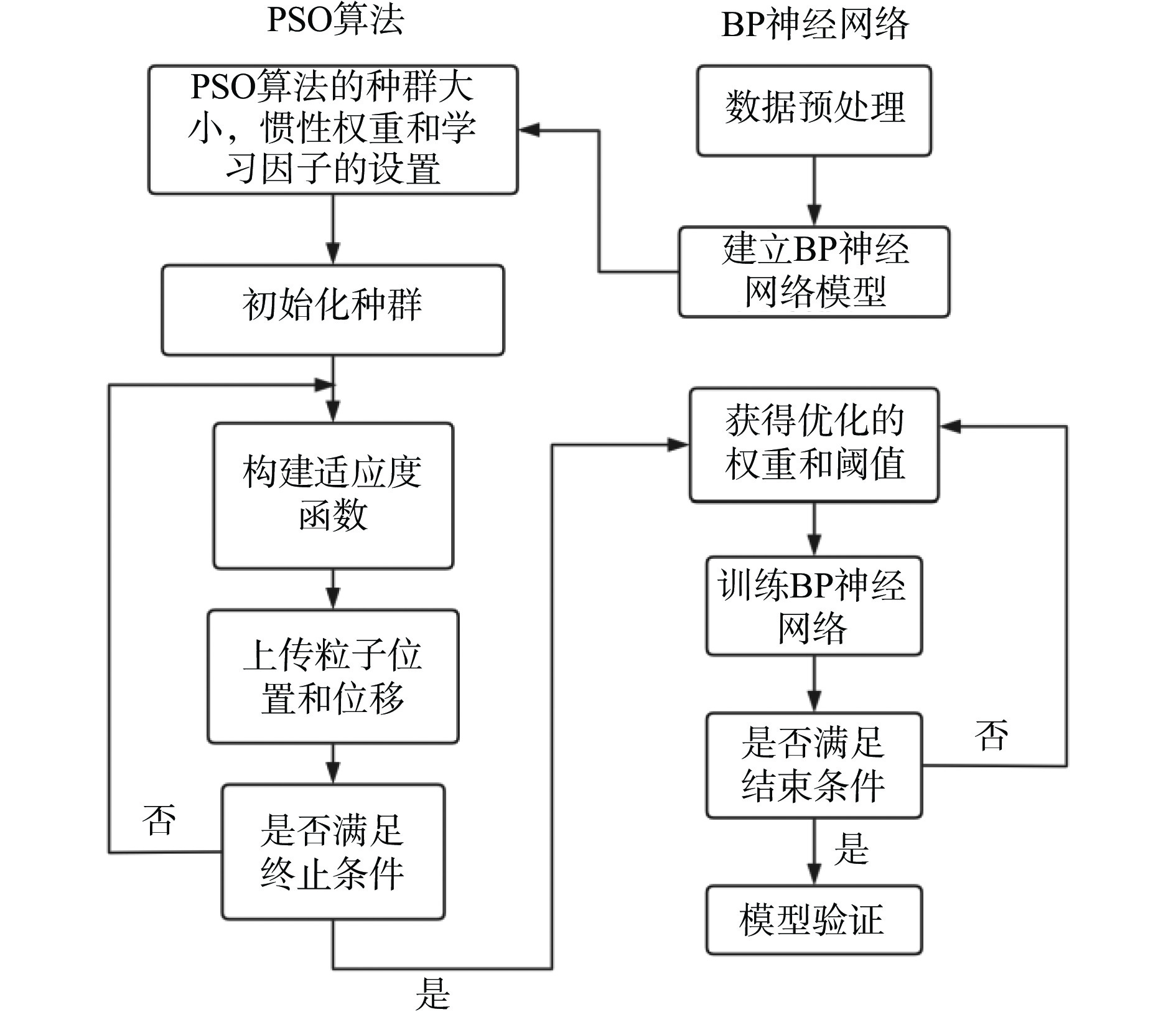
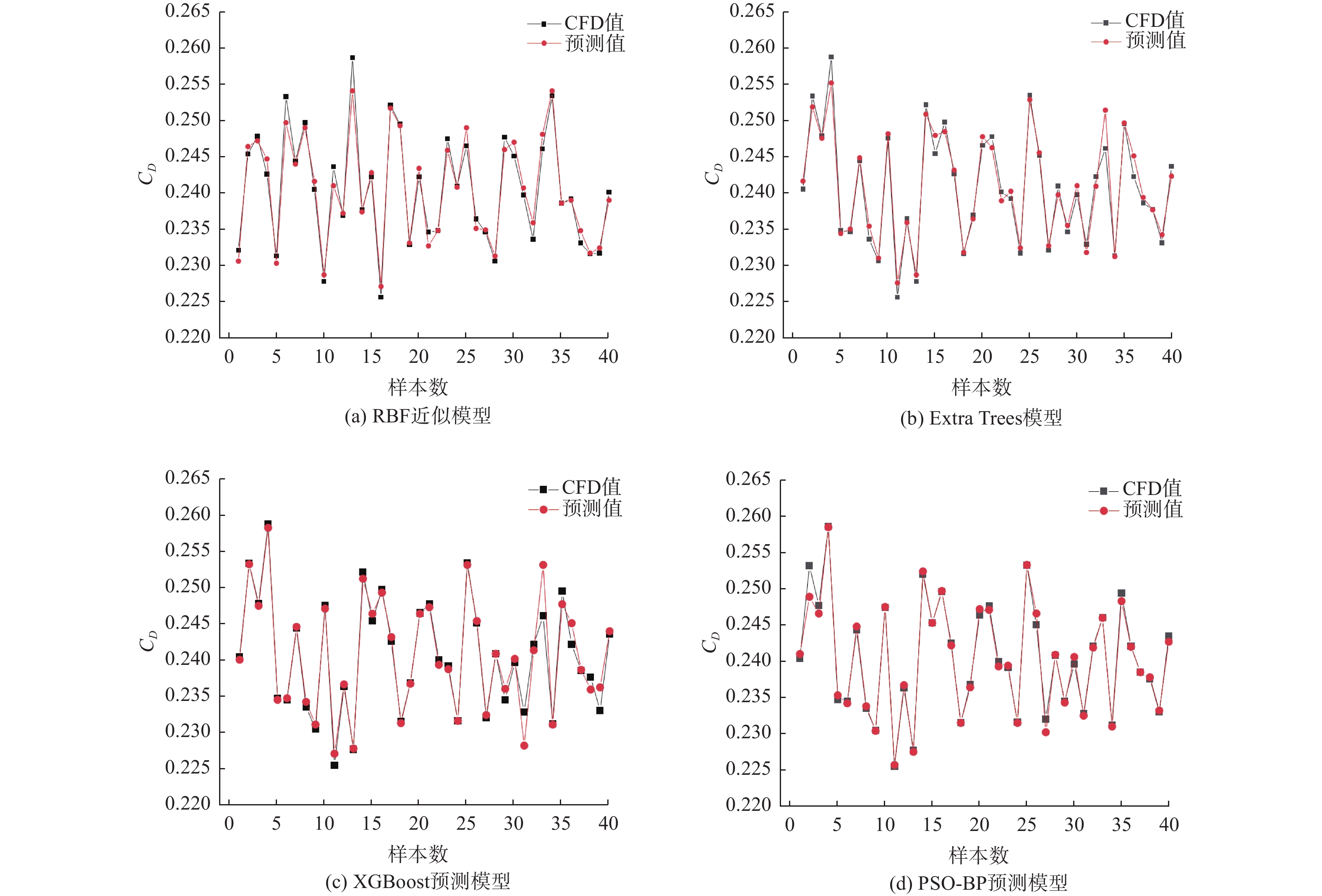
摘要: 扩散器是一种先进的空气动力学改进装置,通过有效引导气流来降低车辆的阻力系数。为降低汽车空气动力学性能开发的时间成本,将其安装在Ahmed模型侧面,扩散器的特征尺寸作为设计变量,阻力系数为响应值。采用最优拉丁超立方实验设计(DOE)方法生成DOE矩阵。再运用Fluent求解每组实验方案的阻力系数仿真值。构建数据集后,应用于径向基函数(RBF)、极端随机树(Extra Trees)、极限梯度提升树(XGBoost)、粒子群优化−反向传播(PSO-BP)等模型,结果表明PSO-BP模型预测精度最佳,RBF模型最差。通过Extra Trees算法分析5个设计变量对阻力系数的影响程度,影响最大的变量为X1,影响最小的变量为X5,由此可得机器学习应用于汽车空气动力学设计的可行性。
-
关键词:
- 机器学习 /
- 极端随机树 /
- 极限梯度提升 /
- 粒子群优化−反向传播混合算法 /
- 阻力系数
Abstract: A diffuser is an advanced aerodynamic improvement device that reduces the drag coefficient of a vehicle by efficiently guiding airflow. To reduce the time required for developing vehicle aerodynamic performance, it was mounted on the sides of the Ahmed model, with the characteristic dimensions of the diffuser serving as design variables and the drag coefficient as the response. The optimal Latin hypercube experimental design method was employed to generate the design of experiments (DOE) matrix. Subsequently, Fluent was used to solve the simulated drag coefficients for each experimental scenario. After the dataset was constructed, it was applied to several machine learning models, including radial basis function (RBF), Extra Trees, extreme gradient boosting (XGBoost), and particle swarm optimization-backpropagation (PSO-BP). The results demonstrated that the PSO-BP model achieved the best prediction accuracy, whereas the RBF model performed the worst. Finally, the Extra Trees algorithm was used to analyze the influence of five design variables on the drag coefficient. The X1 exerted the highest influence, while X5 had the least. This demonstrates that the application of machine learning to automobile aerodynamic design is feasible. -
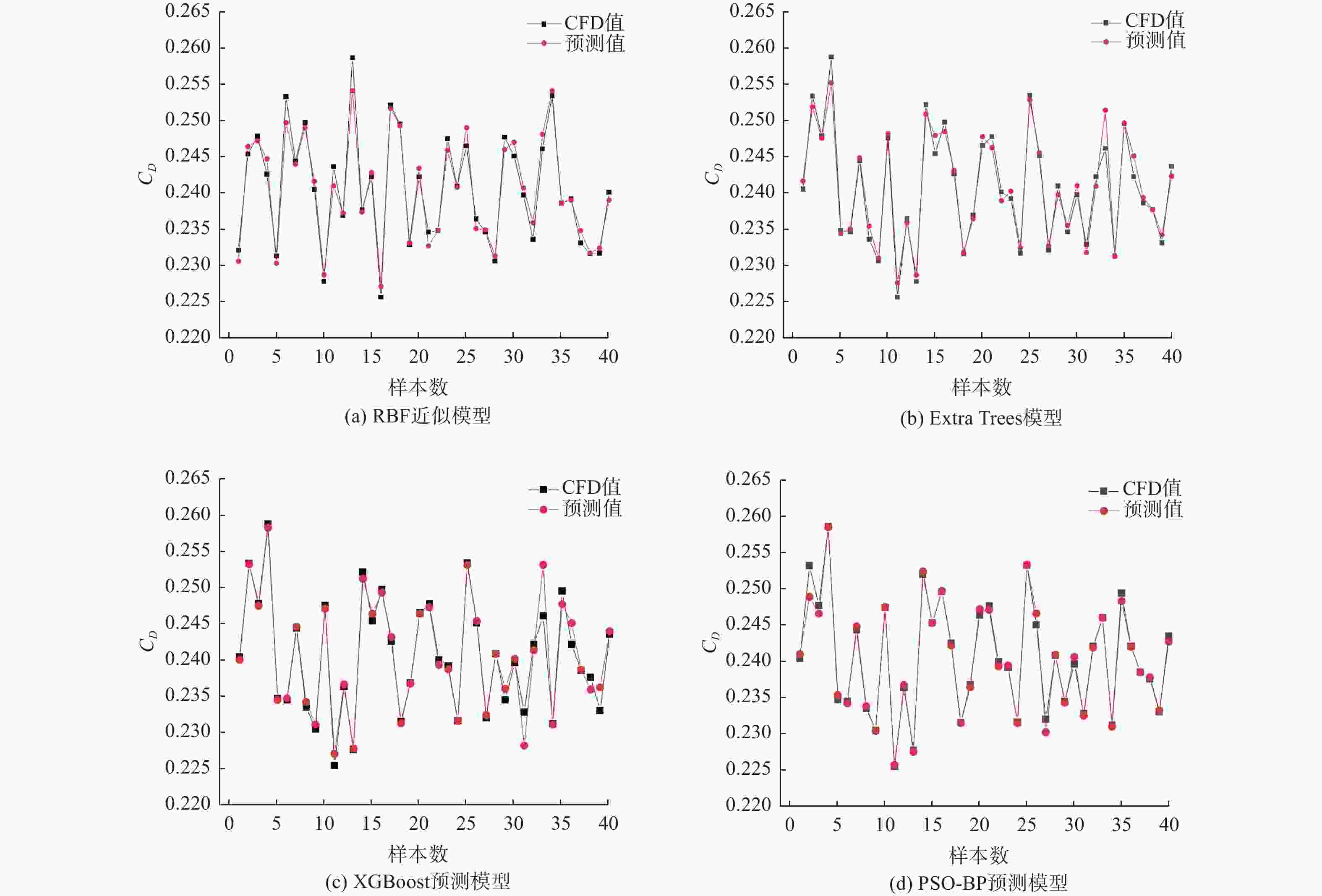
图 6 不同预测模型的拟合效果对比
Figure 6. Comparison of fitting effects of different prediction models
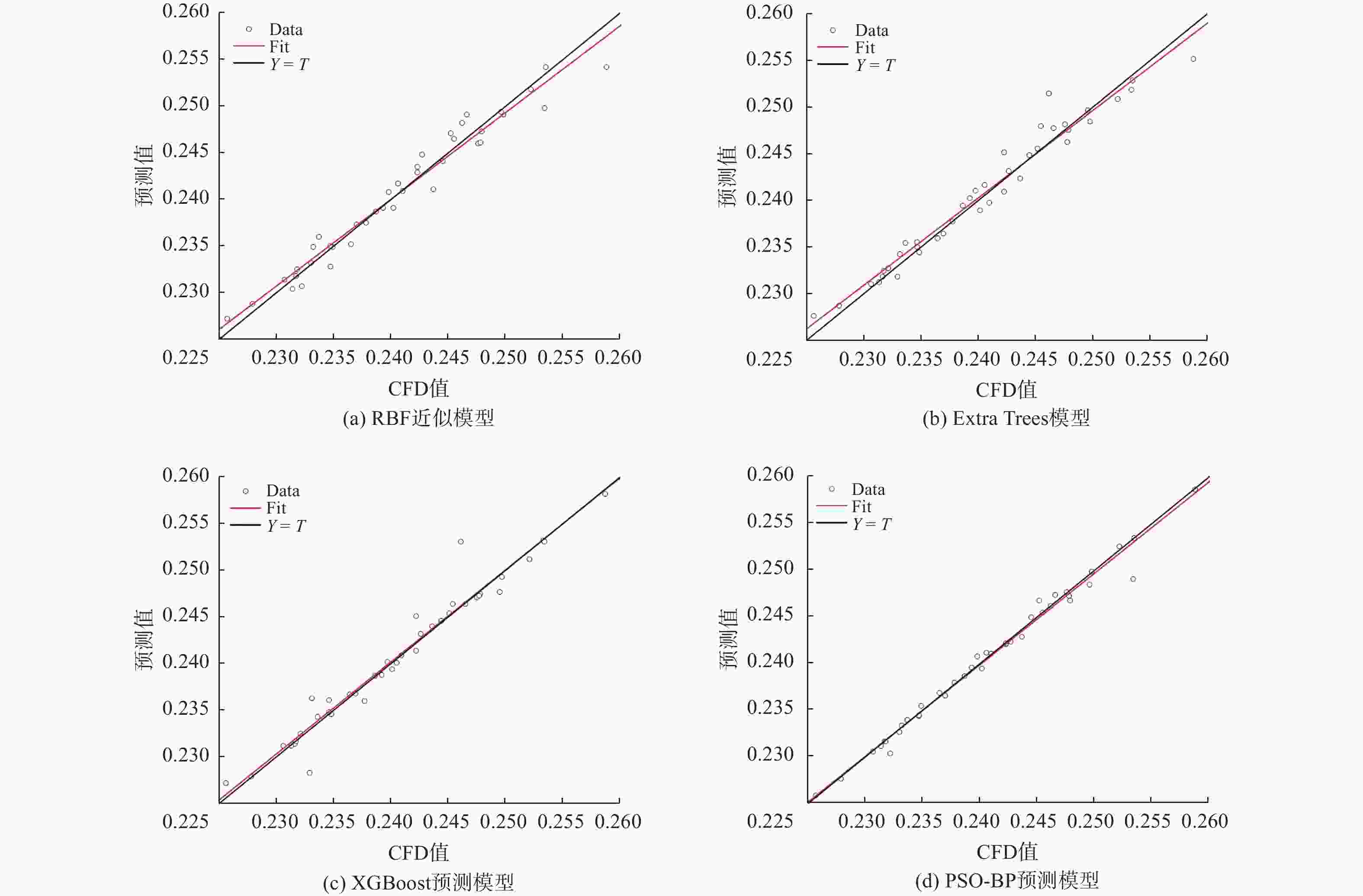
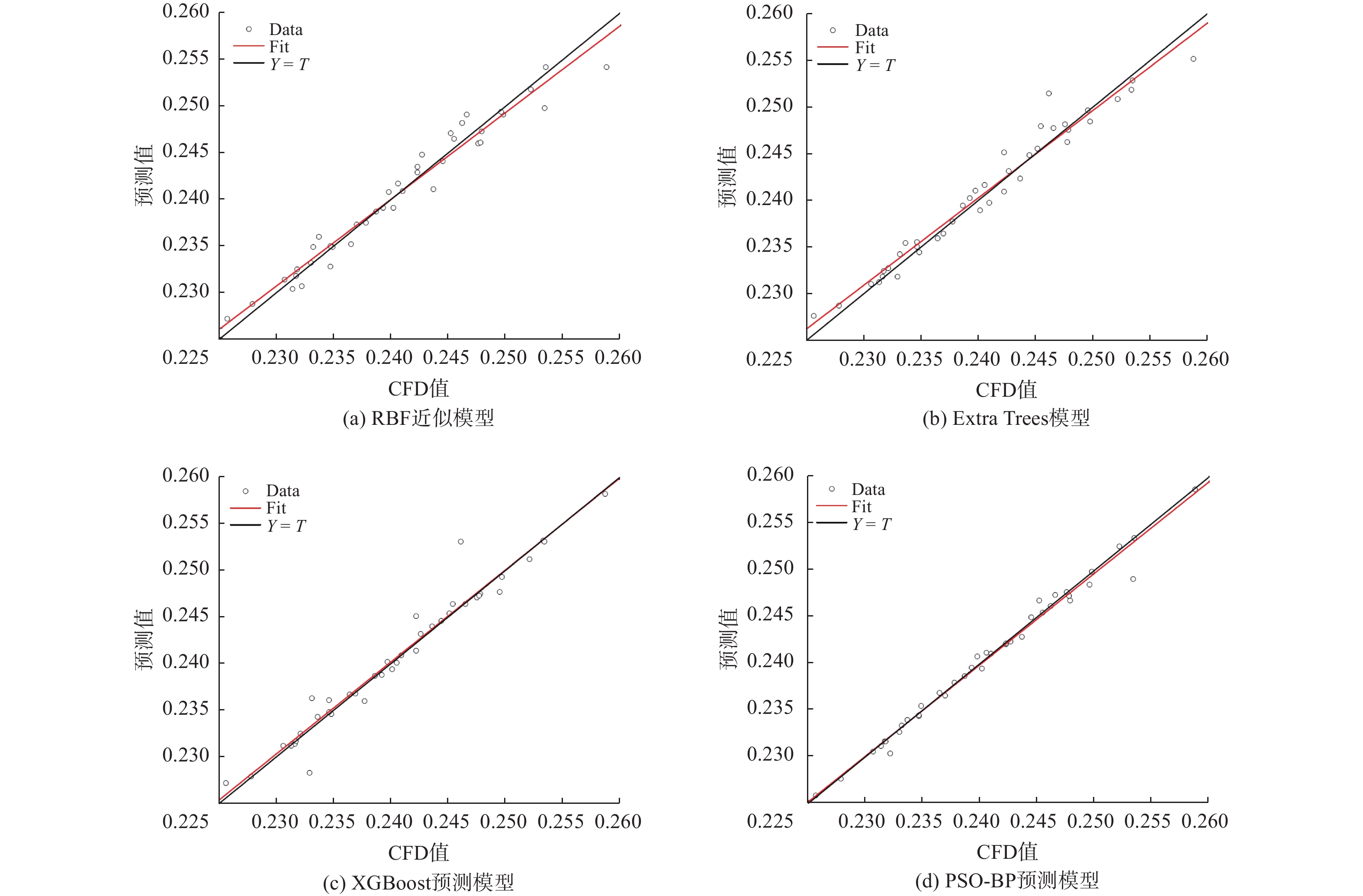
图 7 不同预测模型的回归曲线图对比
Figure 7. Comparison of regression graphs of different prediction models
表 1 不同网格尺寸的阻力系数
Table 1. Drag coefficients for different grid sizes
体网格数/104 阻力系数CD 误差/% 165 0.3247 13.92 202 0.3237 13.58 307 0.3154 10.67 397 0.3082 8.14 528 0.3076 7.93 556 0.2932 2.88 796 0.2932 2.88 实验值 0.2850 [7]—  下载: 导出CSV
表 2 设计变量取值范围
Table 2. Range of values of design variables
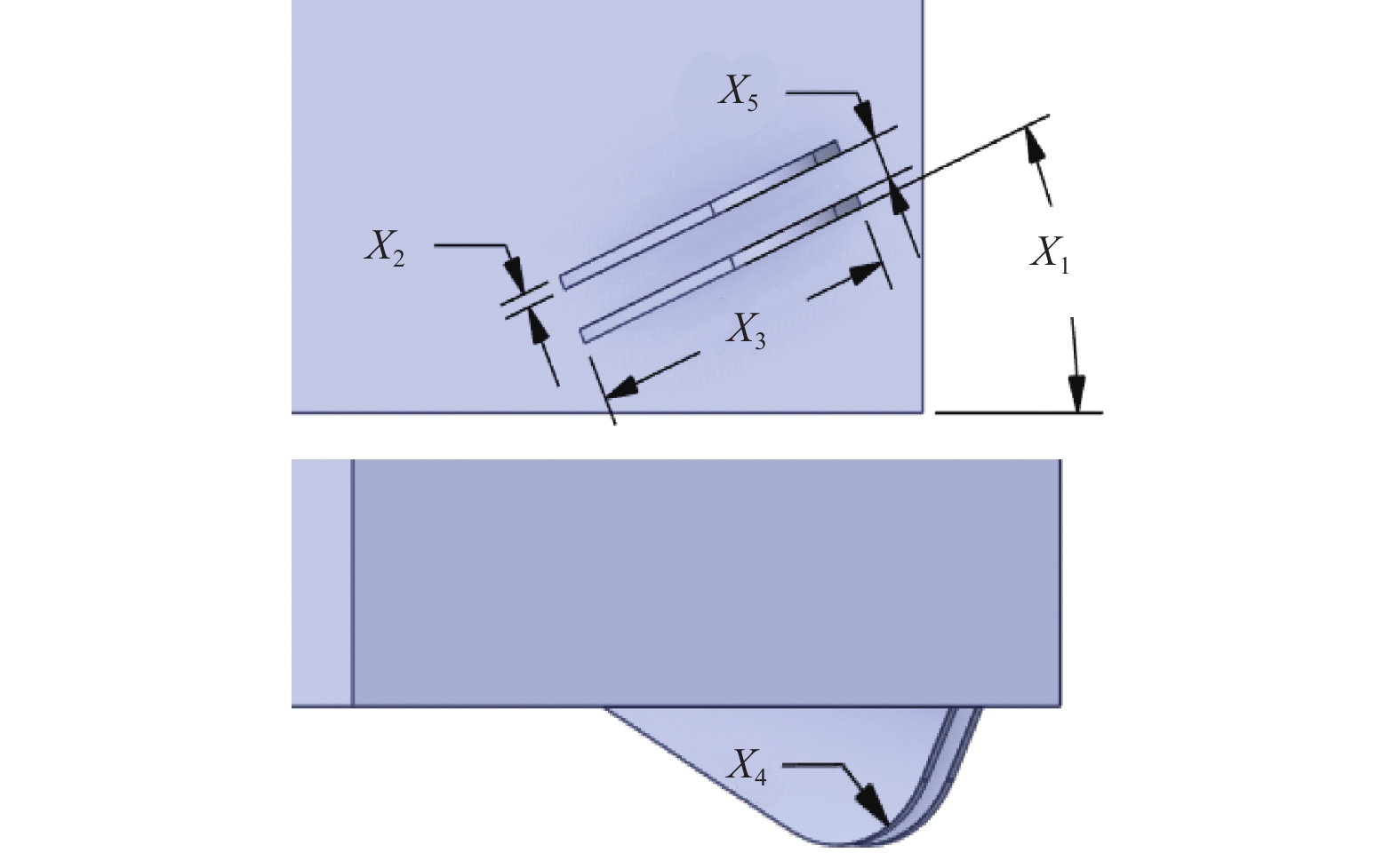
设计变量名 取值范围 扩散器与水平面的夹角X1/(°) [15°, 30°] 扩散器的厚度X2/mm [5, 15] 扩散器的长度X3/mm [100, 150] 扩散器的过渡圆角半径X4/mm [10, 35] 两个扩散器的间距X5/mm [10, 25]
下载: 导出CSV
表 3 数据集
Table 3. Datasets
样本数 X1 X2 X3 X4 X5 CD 1 25.00 9.62 101.28 17.69 23.08 0.2422 2 21.92 10.38 144.87 16.41 11.15 0.2386 $\vdots $ $\vdots $ $\vdots $ $\vdots $ $\vdots $ $\vdots $ $\vdots $ 39 19.23 7.82 128.21 12.56 24.62 0.2331 40 23.85 5.00 111.54 23.46 18.85 0.2436
下载: 导出CSV
表 5 Extra Trees模型参数设置
Table 5. Extra Trees model parameter settings
参数名 参数值 数据切分 0.7 节点分裂评价准则 MSE 内部节点分裂的最小样本数 2 叶子节点的最小样本数 1 叶子节点中样本的最小权重 0 树的最大深度 10 叶子节点的最大数量 50 决策树数量 100
下载: 导出CSV
表 6 XGBoost模型参数设置
Table 6. XGBoost model parameter settings
参数名 参数值 数据切分 0.7 基学习器 gbtree 基学习器数量 100 学习率 0.1 L1正则项 0 L2正则项 1 样本征采样率 1 树特征采样率 1 节点特征采样率 1 叶子节点中样本的最小权重 0 树的最大深度 10
下载: 导出CSV
表 4 拟合模型回归曲线的决定系数和均方根误差对比
Table 4. Comparison of R2 and RMSE of regression curve of fitted model
模型 R2 RMSE RBF 0.9607 0.0017 Extra Trees 0.9816 0.0015 XGBoost 0.9781 0.0016 PSO-BP 0.9933 0.0009
下载: 导出CSV
-
[1] ROSTAMZADEH-RENANI M, BAGHOOLIZADEH M, SAJADI S M, et al. A multi-objective and CFD based optimization of roof-flap geometry and position for simultaneous drag and lift reduction[J] . Propulsion and Power Research, 2024, 13(1): 26 − 45. doi: 10.1016/j.jppr.2024.02.004 [2] GUNPINAR E, COSKUN U C, OZSIPAHI M, et al. A generative design and drag coefficient prediction system for Sedan car side silhouettes based on computational fluid dynamics[J] . Computer-Aided Design, 2019, 111: 65 − 79. doi: 10.1016/j.cad.2019.02.003 [3] ANDRÉS-PÉREZ E, PAULETE-PERIÁÑEZ C. On the application of surrogate regression models for aerodynamic coefficient prediction[J] . Complex & Intelligent Systems, 2021, 7(4): 1991 − 2021. [4] 姜丰, 李卓, 汪怡平. 基于GA-BP神经网络的汽车空气阻力系数预测研究[J] . 汽车工程学报, 2023, 13(5): 730 − 738. [5] 侯卜瑛, 赵萌, 刘印桢, 等. 不同侧风角作用下Ahmed模型空气动力学特性分析[J] . 科学技术与工程, 2024, 24(2): 465 − 471. [6] 许建民, 龚晓岩, 郑庆杰, 等. 基于联接式通道的厢式货车减阻性能仿真研究[J] . 汽车安全与节能学报, 2023, 14(6): 774 − 782. [7] 张勇, 石佳琦, 谷正气, 等. 尾部特征参数对气动阻力交互影响与全局优化研究[J] . 湖南大学学报(自然科学版), 2020, 47(2): 14 − 20. [8] JIANG Q H, ZHU L L, SHU C, et al. An efficient multilayer RBF neural network and its application to regression problems[J] . Neural Computing and Applications, 2022, 34(6): 4133 − 4150. doi: 10.1007/s00521-021-06373-0 [9] GAVEL A, ANDRAE R, FOUESNEAU M, et al. Estimating [α/Fe] from Gaia low-resolution BP/RP spectra using the ExtraTrees algorithm[J] . Astronomy & Astrophysics, 2021, 656: A93. [10] 李笑雪, 张思凝, 王娅娅, 等. 基于树型学习算法的短期流量预测研究[J] . 电子测试, 2021(19): 48 − 50. [11] CHEN T Q, CARLOS G. XGBoost: a scalable tree boosting system[C] //Proceedings of the 22nd ACM SIGKDD International Conference on Knowledge Discovery and Data Mining. San Francisco: Association for Computing Machinery, 2016: 785 − 794. [12] PARK D, CHA J, KIM M, et al. Multi-objective optimization and comparison of surrogate models for separation performances of cyclone separator based on CFD, RSM, GMDH-neural network, back propagation-ANN and genetic algorithm[J] . Engineering Applications of Computational Fluid Mechanics, 2020, 14(1): 180 − 201. doi: 10.1080/19942060.2019.1691054 [13] 蔡改贫, 罗茜茜, 刘鑫. 基于PSO-LSSVM的Ni-Cr-W-Mo合金本构关系研究[J] . 塑性工程学报, 2020, 27(9): 140 − 146. [14] BAGHERI-ESFEH H, ROSTAMZADEH-RENANI M, ROSTAMZADEH-RENANI R, et al. Multi-objective optimization of drag and lift coefficients of a car integrated with canards[J] . International Journal of Computational Fluid Dynamics, 2020, 34(5): 346 − 362. doi: 10.1080/10618562.2020.1766031 -

 下载:
下载:

 点击查看大图
计量
- 文章访问数: 881
- HTML全文浏览量: 456
- PDF下载量: 157
- 被引次数: 0
