




Pedestrian distribution characteristics in L-shaped passageway of subway station
-
摘要: 为定量描述行人在通道宽度方向上的不均衡分布特性,提出行人轨迹带宽度和行人分布离散系数两个指标,并基于概率统计模型提出指标计算方法。选择典型地铁车站L型通道采集视频数据,拟合不同走行阶段(直行区、转弯前缓冲区、转弯区、转弯后缓冲区)不同服务水平下通道宽度方向行人分布概率密度函数,得出行人分布离散系数和行人轨迹带宽度随走行阶段和行人流量的变化规律。结果表明:通道内行人流量越小,行人分布离散程度越大,在转弯前后两个缓冲阶段其变化幅度越大。随着行人流量的增加,不同走行阶段的轨迹带宽度随之增大,转弯阶段其增长速度最快,且转弯时行人分布重心由通道中轴线向通道内侧移动。研究结果可为地铁车站L型通道行人流线的组织以及设施设计提供一定依据。Abstract: To quantitatively describe the uneven distribution characteristics of pedestrians in the direction of passageway width, two indicators—the track belt width and pedestrian distribution dispersion coefficient— were proposed. Calculation methods for these indicators were developed based on a probability and statistics model. Video data were collected from a typical L-shaped passageway in a subway station. The probability density function of pedestrian distribution was fitted under different service levels for various walking stages (straight zone, pre-turn buffer zone, turning zone, and post-turn buffer zone). The dispersion coefficient of pedestrian distribution and the variation law of pedestrian track belt width with walking stage and pedestrian flow were analyzed. The results show that the dispersion degree of pedestrian distribution increases as the pedestrian flow decreases, with greater variation amplitude in the two buffer stages before and after the turn. As pedestrian flow increases, the track belt width expands in all walking stages, with the fastest growth observed during the turning stage. During the turn, the centroid of pedestrian distribution shifts from the central axis of the passageway towards its interior. These insights offer a basis for organizing L-shaped pedestrian flow lines and designing facilities in subway stations.
-
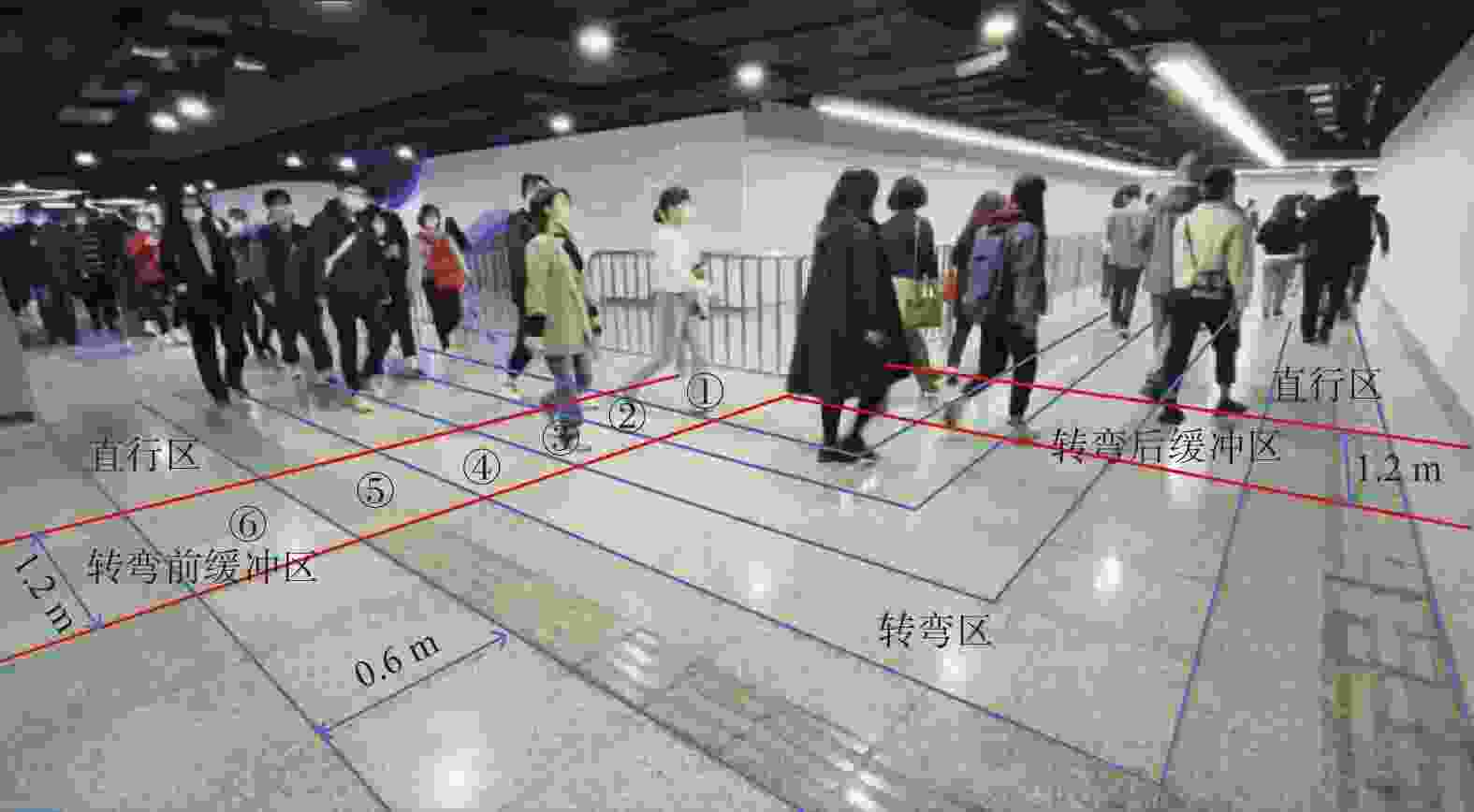
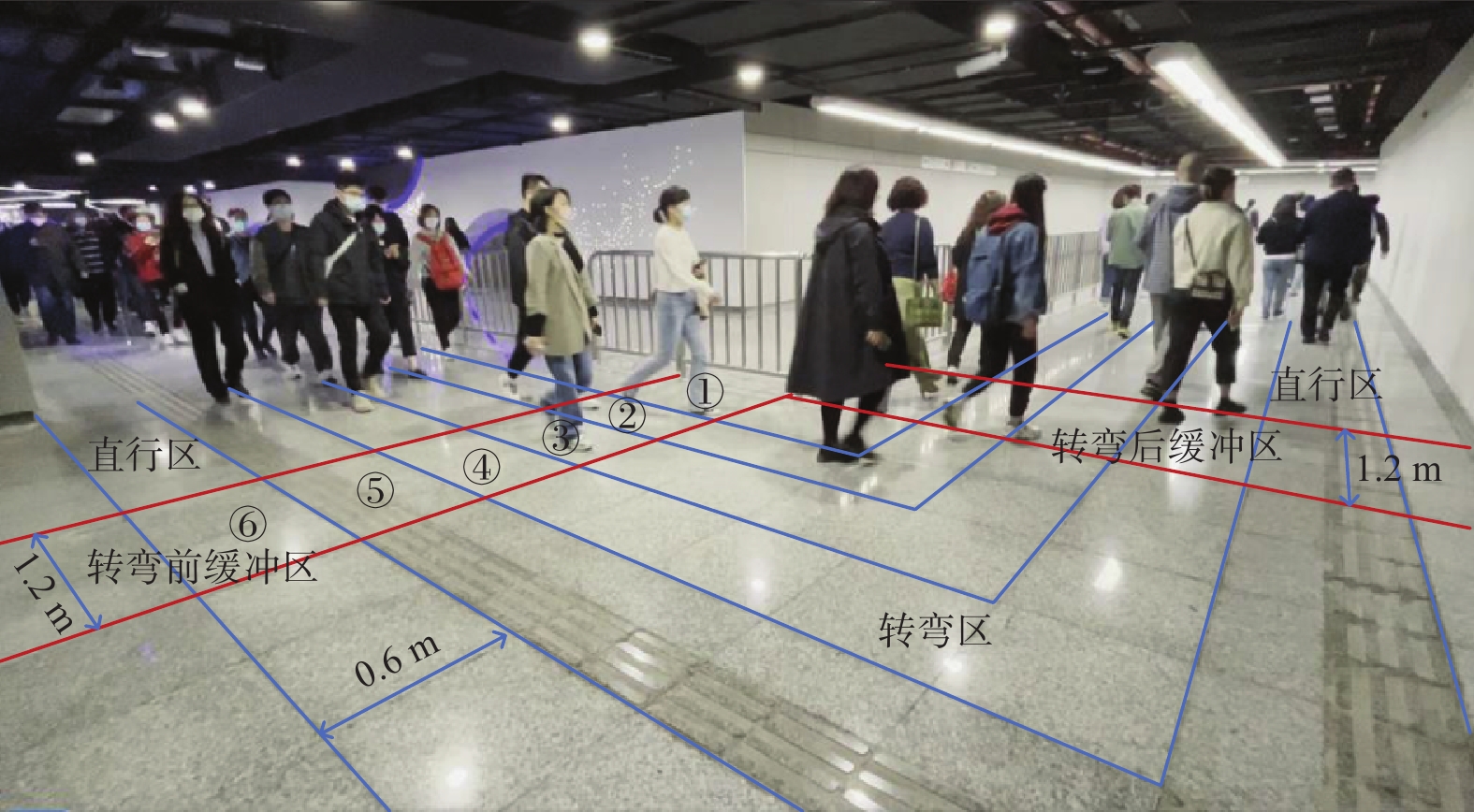
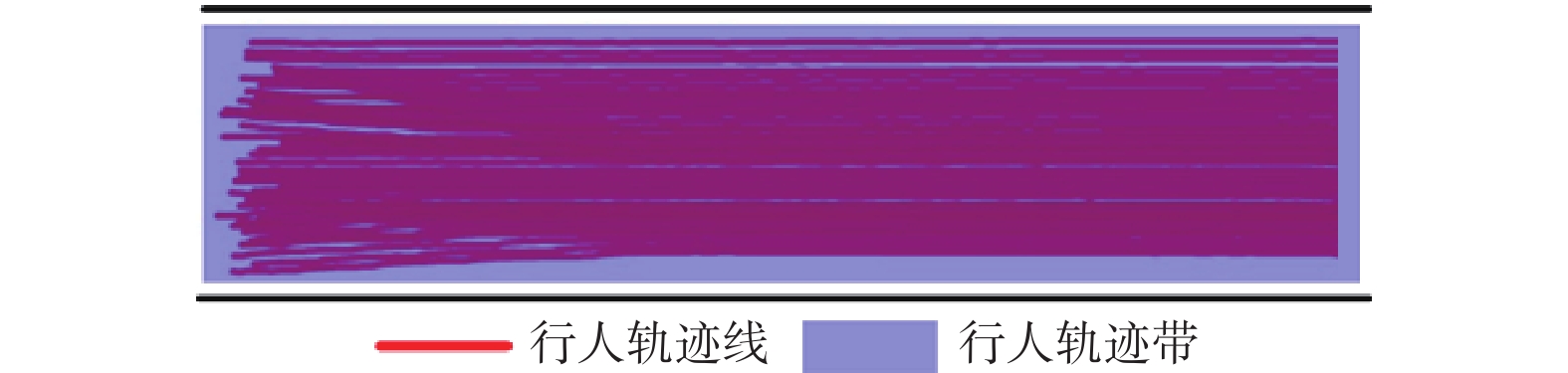
图 4 桂林路站L型通道数据采集场景
Figure 4. Data collection scenario for L-shaped passageway at Guilin Road Station
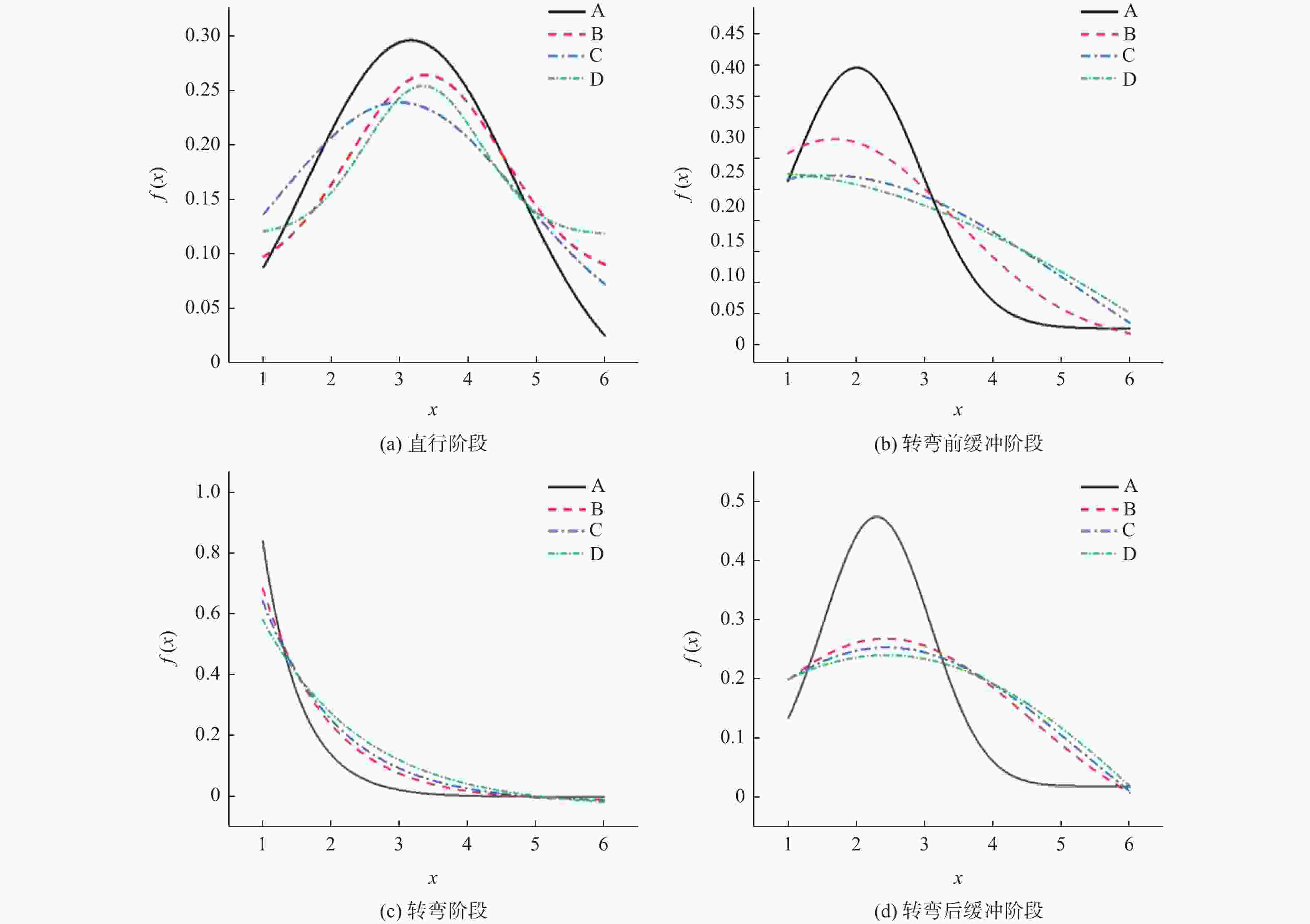
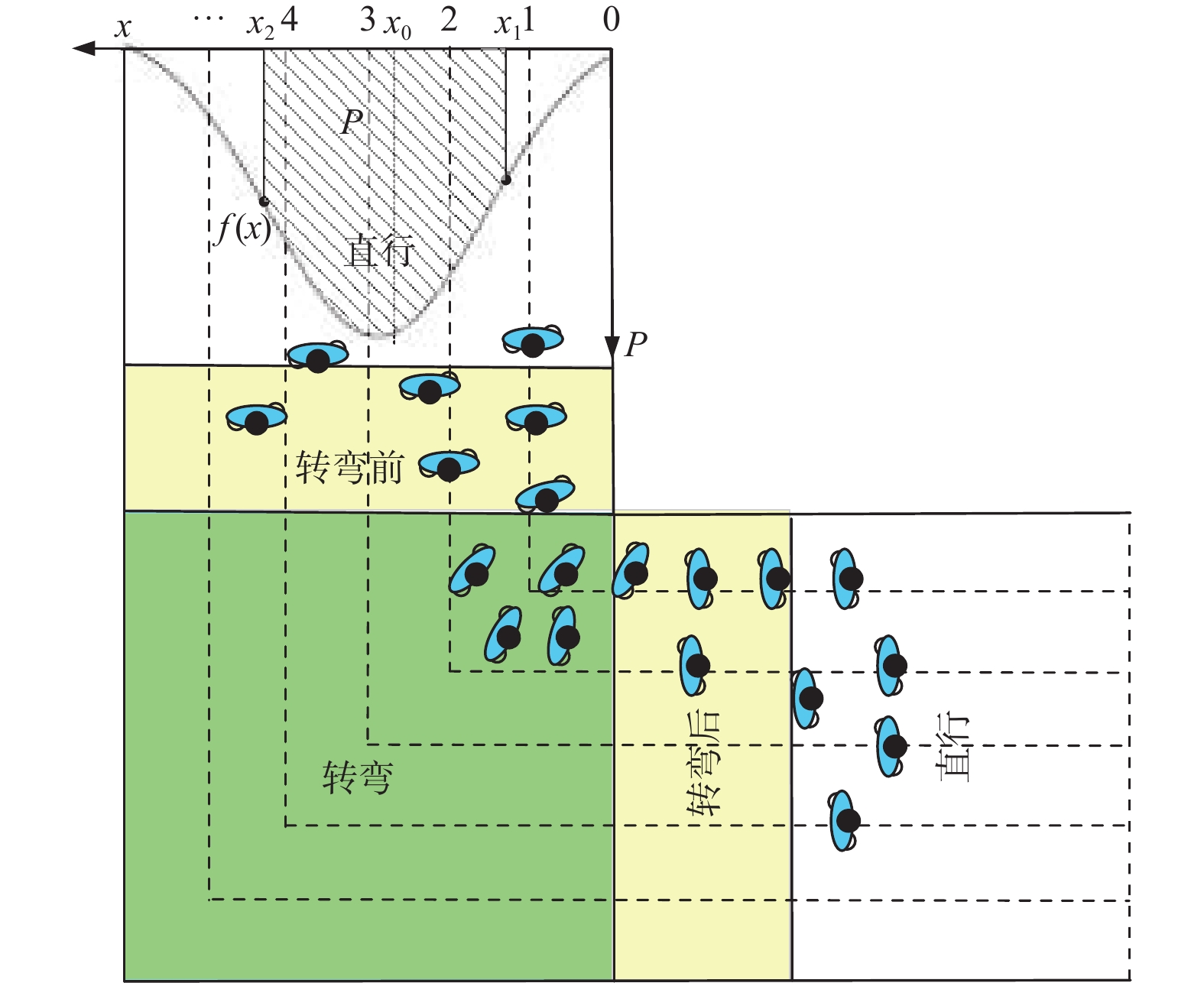
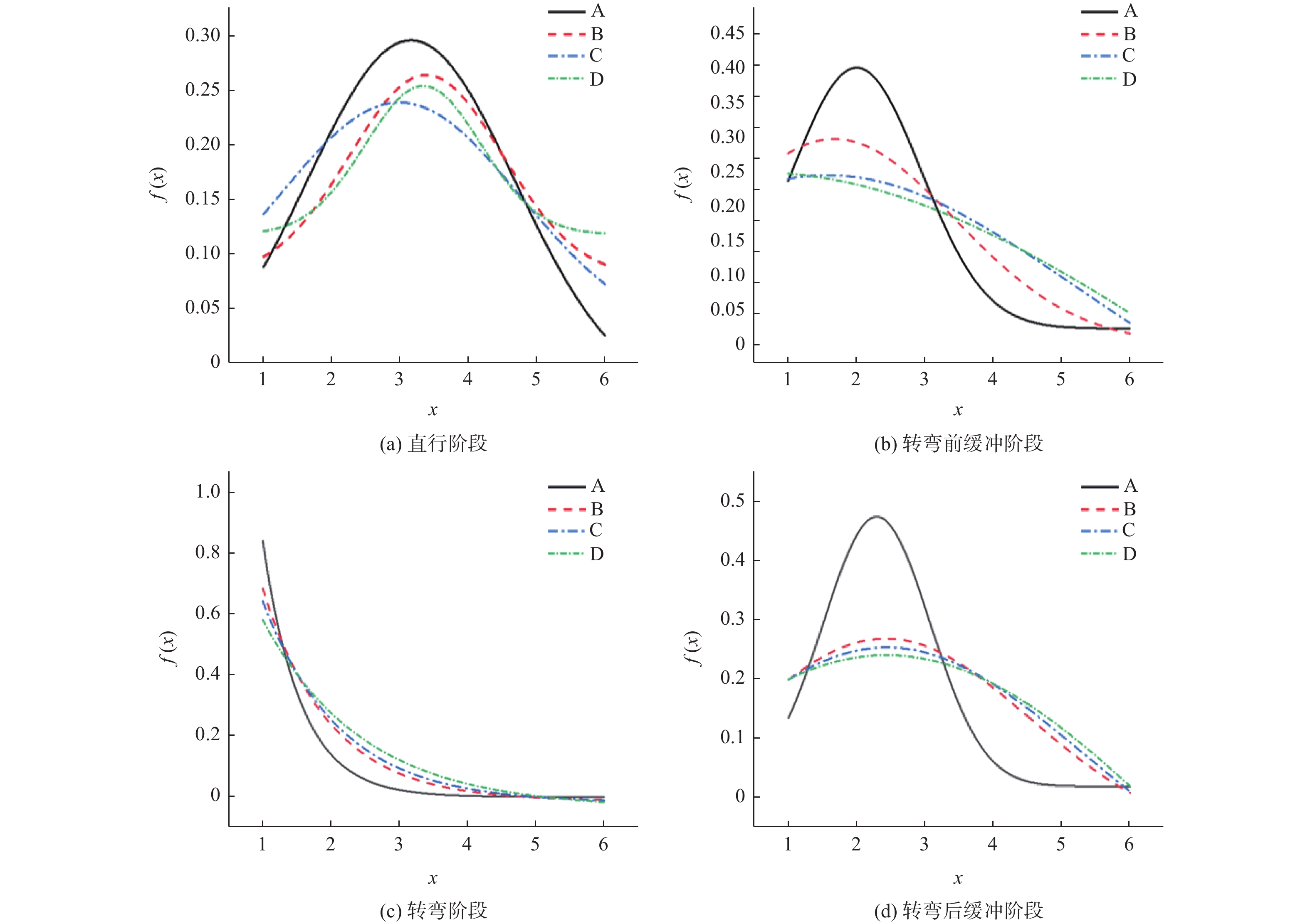
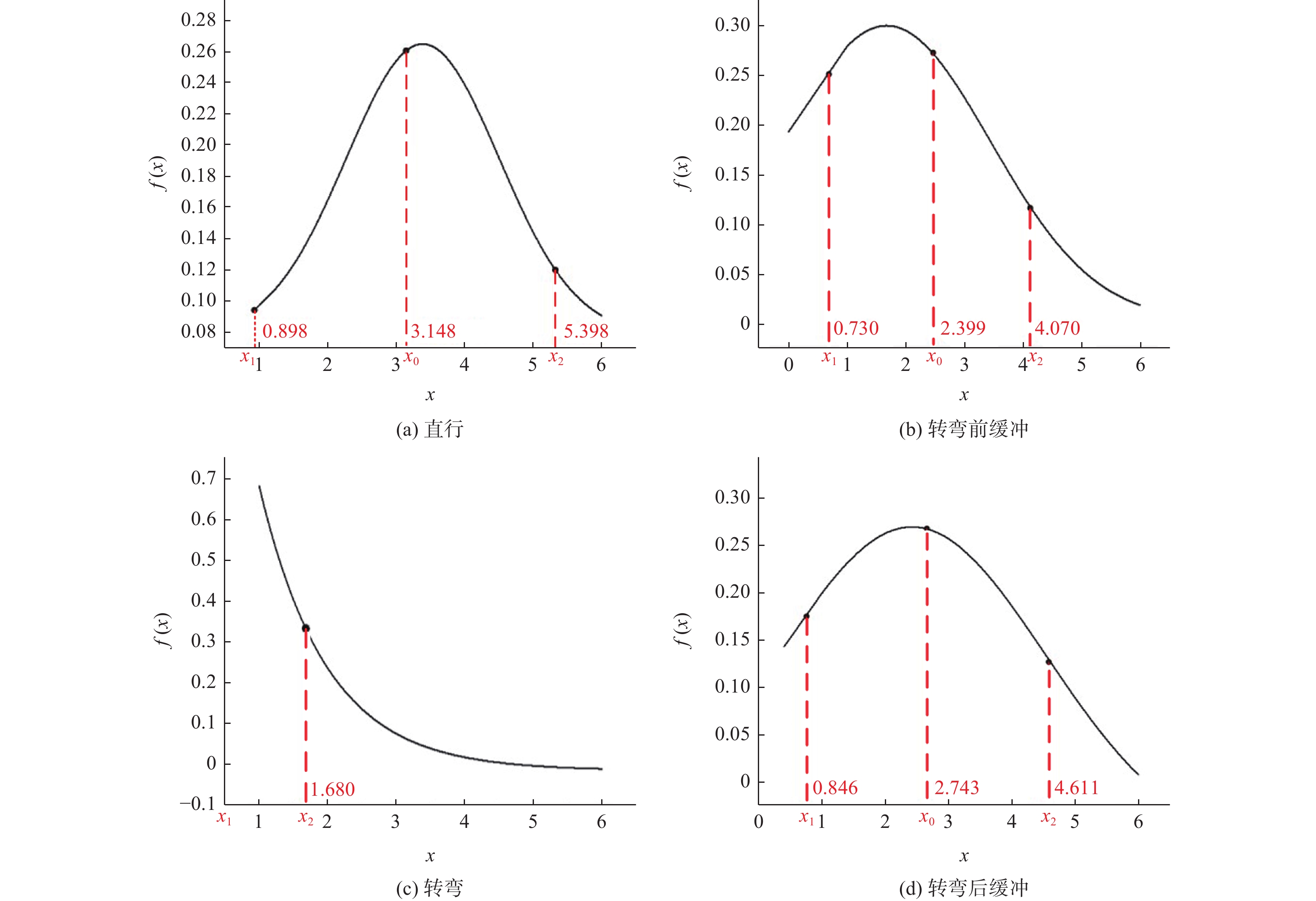
图 5 各级服务水平下行人分布概率函数图
Figure 5. Probability function of pedestrian distribution at different levels of service
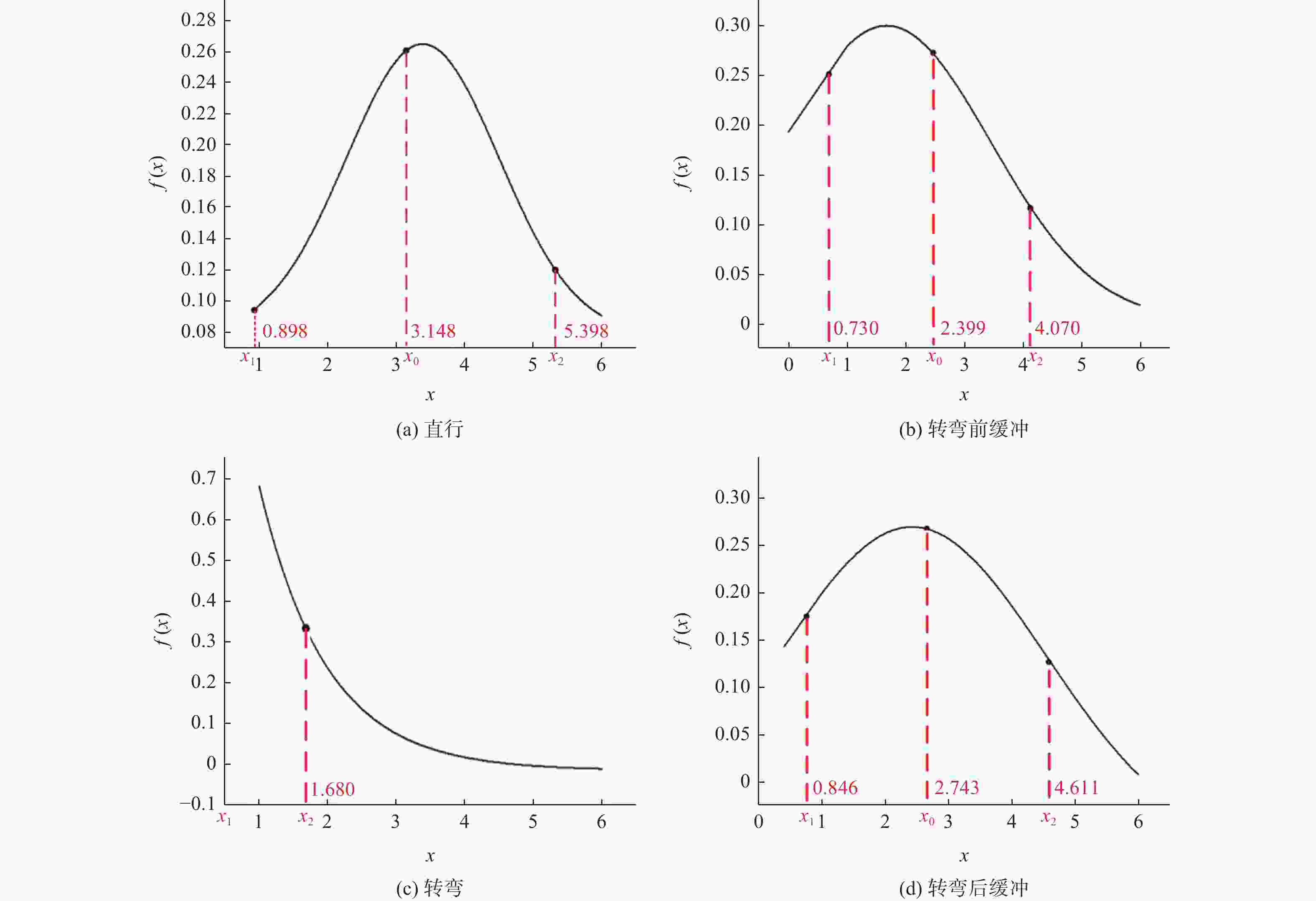
图 6 B级服务水平下的行人分布概率函数拟合图
Figure 6. Fitting diagram of pedestrian distribution probability function at B-level service level
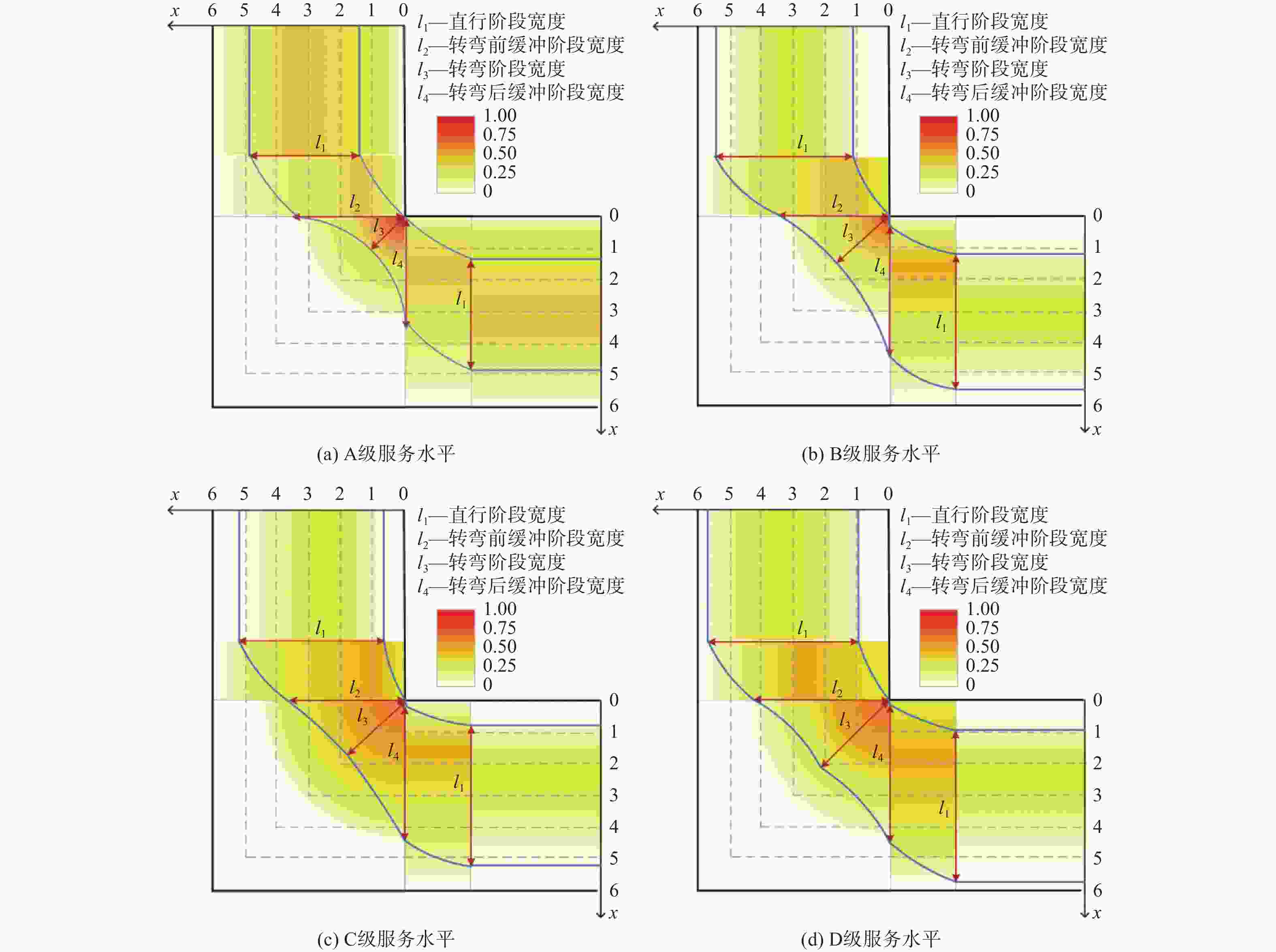
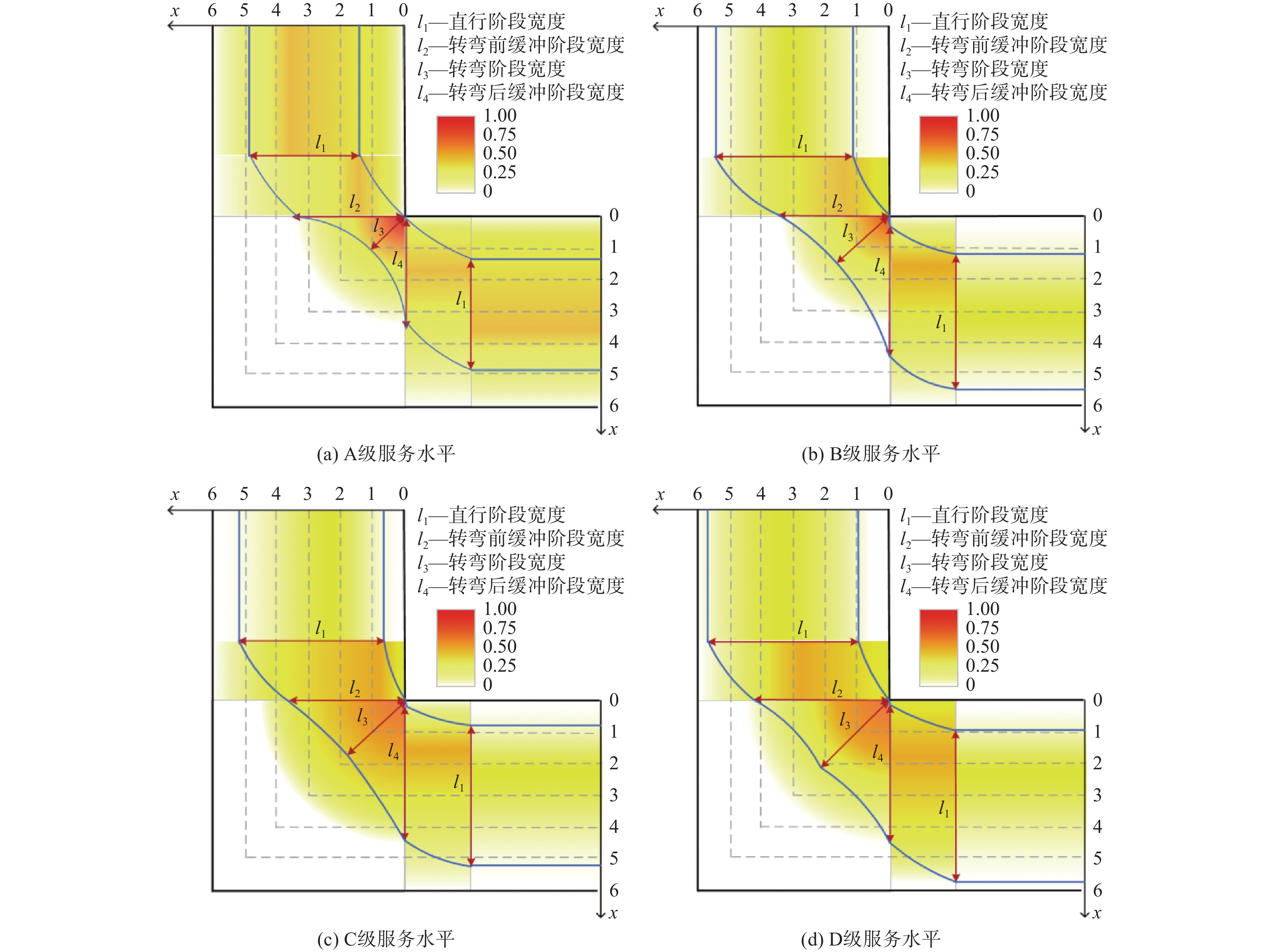
图 7 L型通道行人轨迹带变化特性图
Figure 7. Track belt width variation characteristics in L-shaped passageway
表 1 行人分布概率函数拟合效果检验
Table 1. Fitting effect of pedestrian distribution probability function
服务水平等级 直行 转弯前缓冲 转弯 转弯后缓冲 Reduced Chi-Sqr 调整R2 Reduced Chi-Sqr 调整R2 Reduced Chi-Sqr 调整R2 Reduced Chi-Sqr 调整R2 A 0.003 17 0.734 23 0.000 91 0.961 24 0.000 00 0.999 97 0.000 48 0.984 90 B 0.000 21 0.957 29 0.000 10 0.993 03 0.000 16 0.997 84 0.000 42 0.958 74 C 0.000 04 0.990 28 0.000 10 0.985 85 0.000 20 0.996 83 0.000 01 0.998 40 D 0.000 01 0.995 99 0.000 14 0.977 38 0.000 46 0.991 30 0.000 15 0.979 30  下载: 导出CSV
表 2 L型通道行人分布离散系数
Table 2. Pedestrian distribution dispersion coefficient in L-shaped passageway
服务水平等级 直行阶段 转弯前缓冲阶段 转弯阶段 转弯后缓冲阶段 A 1.041 1.112 2.034 1.202 B 0.443 0.724 1.626 0.636 C 0.407 0.539 1.526 0.582 D 0.336 0.477 1.382 0.516
下载: 导出CSV
表 3 L型通道轨迹带宽度
Table 3. Track belt width in L-shaped passageway
走行阶段 A级 B级 C级 D级 x1 x2 l85% x1 x2 l85% x1 x2 l85% x1 x2 l85% 直行 1.32 4.98 2.20 0.90 5.40 2.70 0.84 5.22 2.63 4.98 2.20 2.85 转弯前缓冲 0.76 3.72 1.78 0.73 4.07 2.00 0.67 4.71 2.42 3.72 1.78 2.50 转弯 0.00 1.05 0.63 0.00 1.68 1.01 0.00 1.87 1.12 1.05 0.63 1.30 转弯后缓冲 0.88 3.60 1.63 0.85 4.61 2.26 0.86 4.76 2.34 3.60 1.63 2.42
下载: 导出CSV
表 4 L型通道轨迹带宽度变化情况
Table 4. Track belt width variation in L-shaped passageway
走行阶段 B级增长率/% C级增长率/% D级增长率/% 直行 22.89 19.57 29.77 转弯前缓冲 12.84 36.49 40.54 转弯 60.00 78.10 106.67 转弯后缓冲 38.42 43.38 48.41
下载: 导出CSV
-
[1] 聂广渊, 袁振洲, 吴昊灵. 基于AnyLogic仿真的城市轨道交通枢纽通道宽度研究[J] . 城市轨道交通研究, 2016, 19(6): 34 − 38. doi: 10.16037/j.1007-869x.2016.06.007 [2] ZHANG J, KLINGSCH W, RUPPRECHT T, et al. Empirical study of turning and merging of pedestrian streams in T-junction[J] . arXiv preprint arXiv: 1112.5299, 2011. [3] YE R, CHRAIBI M, LIU C, et al. Experimental study of pedestrian flow through right-angled corridor: uni- and bidirectional scenarios[J] . Journal of Statistical Mechanics: Theory and Experiment, 2019, 2019(4): 043401. doi: 10.1088/1742-5468/ab0c13 [4] CHRAIBI M, FREIALDENHOVEN M, SCHADSCHNEIDER A, et al. Modeling the desired direction in a force-based model for pedestrian dynamics[C] //Proceedings of Traffic and Granular Flow '11. Moscow: Springer, 2012: 263−275. [5] GAO Y X, CHEN F, WANG Z J. Hybrid dynamic route planning model for pedestrian microscopic simulation at subway station[J] . Journal of Advanced Transportation, 2019, 2019: 5207814. [6] 朱昭俊, 李雪芹, 白旭. 行人异质性因素影响下地铁站通道通行能力研究[J] . 综合运输, 2022, 44(12): 100 − 105. doi: 10.20164/j.cnki.cn11-1197/u.2022.12.017 [7] Transportation Research Board. Highway capacity manual 2000[M] . Washington: Transportation Research Board, 2000. [8] 张蕊, 杨静, 杨晨威, 等. 考虑结伴行为的地铁通道行人仿真建模研究[J] . 交通运输系统工程与信息, 2019, 19(5): 163 − 168. doi: 10.16097/j.cnki.1009-6744.2019.05.023 [9] WANG P, CAO S C, YAO M. Fundamental diagrams for pedestrian traffic flow in controlled experiments[J] . Physica A: Statistical Mechanics and its Applications, 2019, 525: 266 − 277. doi: 10.1016/j.physa.2019.03.057 [10] 武鑫森, 岳昊, 刘秋梅, 等. L型步行通道内行人转弯行为的实验分析与仿真[J] . 物理学报, 2021, 70(14): 148901. doi: 10.7498/aps.70.20210055 -

 下载:
下载:

 点击查看大图
计量
- 文章访问数: 278
- HTML全文浏览量: 141
- PDF下载量: 105
- 被引次数: 0
