




Optimization of subway train operation plan considering online coupling and decoupling scenarios
-
摘要: 针对城市轨道交通客流时空分布不均,探讨在线编组/解体场景下大小交路列车开行方案的优化问题。以客流两端较少而中间较大的轨道线路为基础,最小化乘客等待时间与列车走行公里数。将列车发车频率、大小交路的编组数量和小交路站点的选择作为决策变量,在考虑编组数、满载率及客流等约束条件下,构建列车开行方案的整数规划优化模型。以某城市轨道交通线路为例,利用两阶段求解算法与CPLEX求解器对模型求解。结果显示,乘客等待时间和列车走行公里数分别降低20.83%和30.09%,显著提升了列车运力与客流需求的匹配度。Abstract: To address the uneven spatial and temporal distribution of passenger flow in urban rail transit, the optimization problem of train operation plans for full-length and short-turn routes under online coupling/decoupling scenarios was investigated. For a rail line with lower passenger demand at both ends and higher demand in the middle, the minimization of passenger waiting time and train travel kilometers was set as the objective. The departure frequency, train composition sizes for full-length and short-turn routes, and the selection of short-turn stations were defined as decision variables. Considering constraints such as train size, load factor, and passenger flow, an integer programming optimization model for the train operation plan was formulated. With a metro line in a certain city as a case study, the model was solved using a two-stage solution algorithm and the CPLEX solver. The results indicate that passenger waiting time and train travel kilometers are reduced by 20.83% and 30.09%, respectively, which significantly improves the matching degree between train capacity and passenger demand.
-

图 1 典型城市轨道交通线路的交路示意图
Figure 1. Schematic diagram of a typical route of urban railway transit line
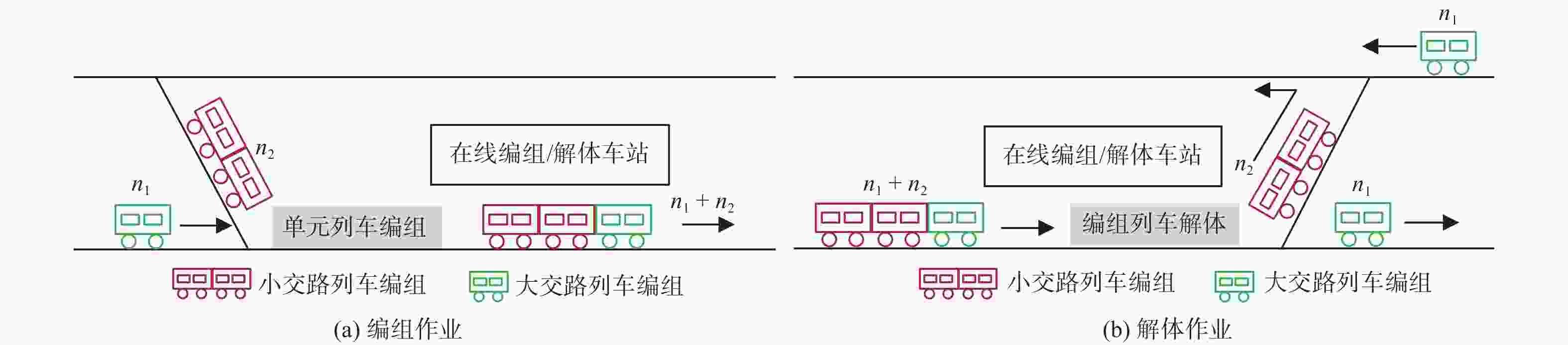
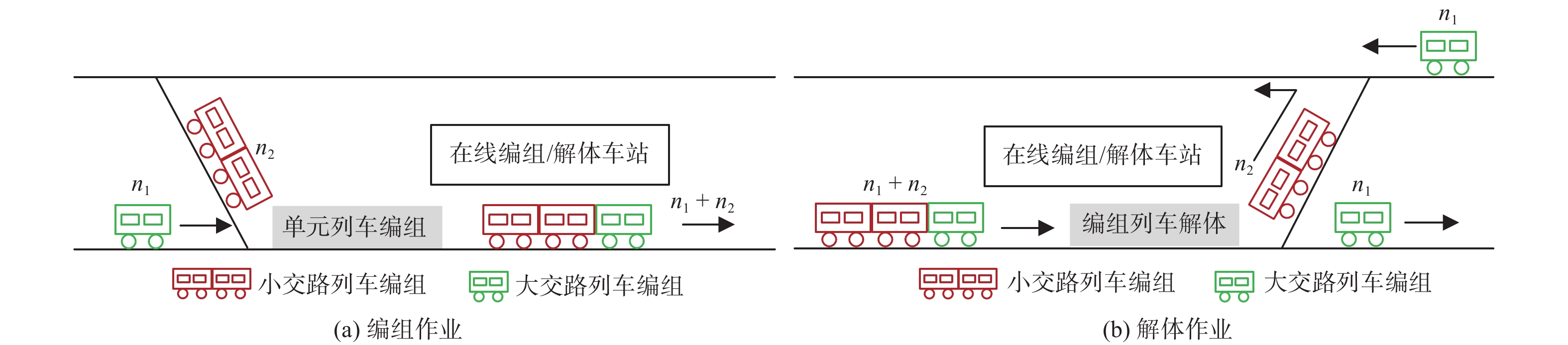
图 2 列车在折返站的编组/解体作业示意图
Figure 2. Schematic diagram of train coupling/decoupling operations at the turnaround station
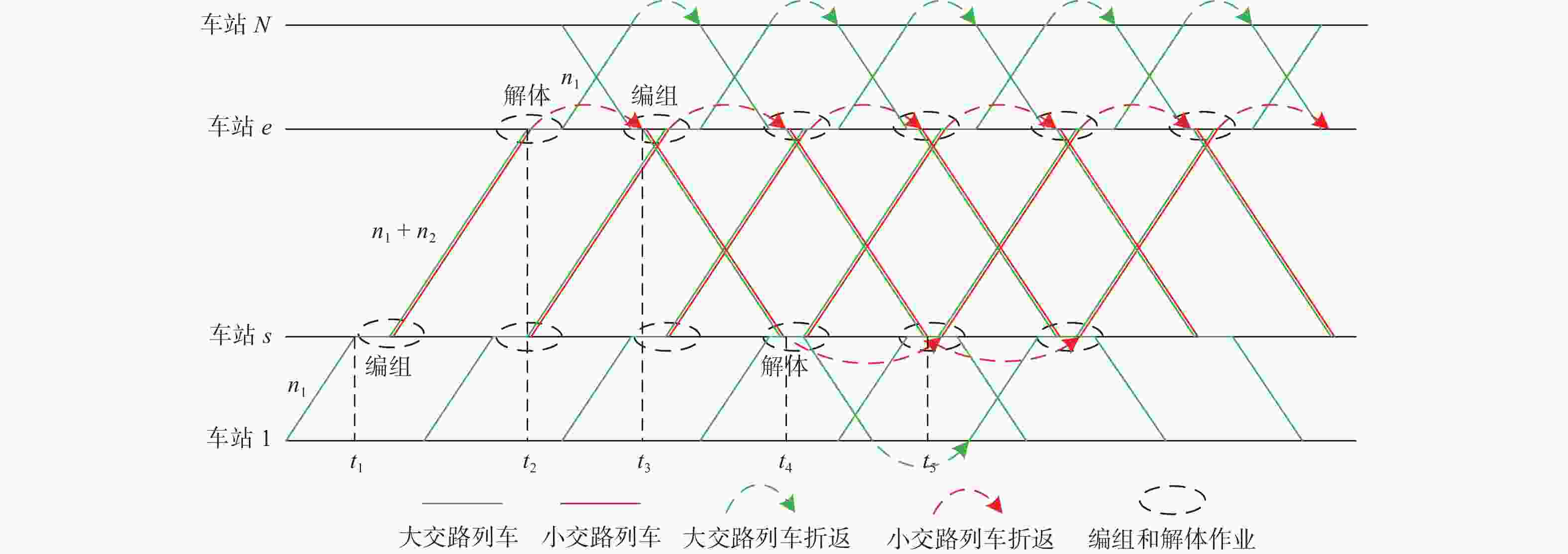
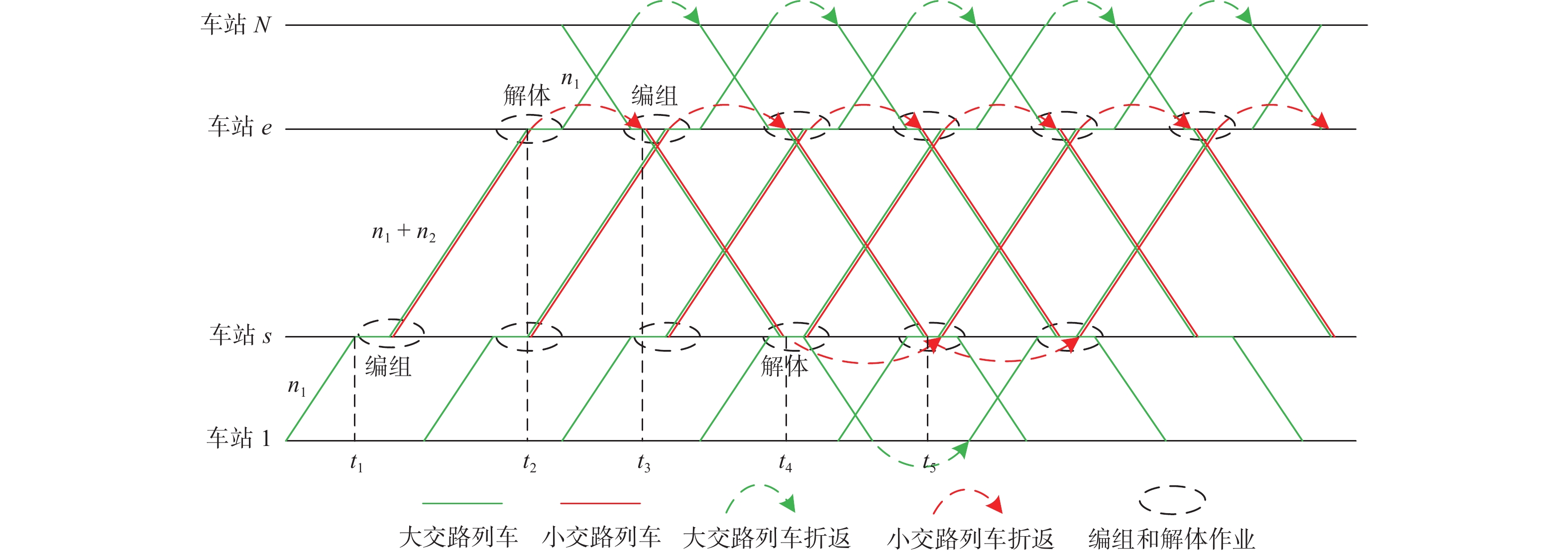
图 3 在线编组/解体模式下的列车运行图
Figure 3. Train operation diagram in online coupling/decoupling mode
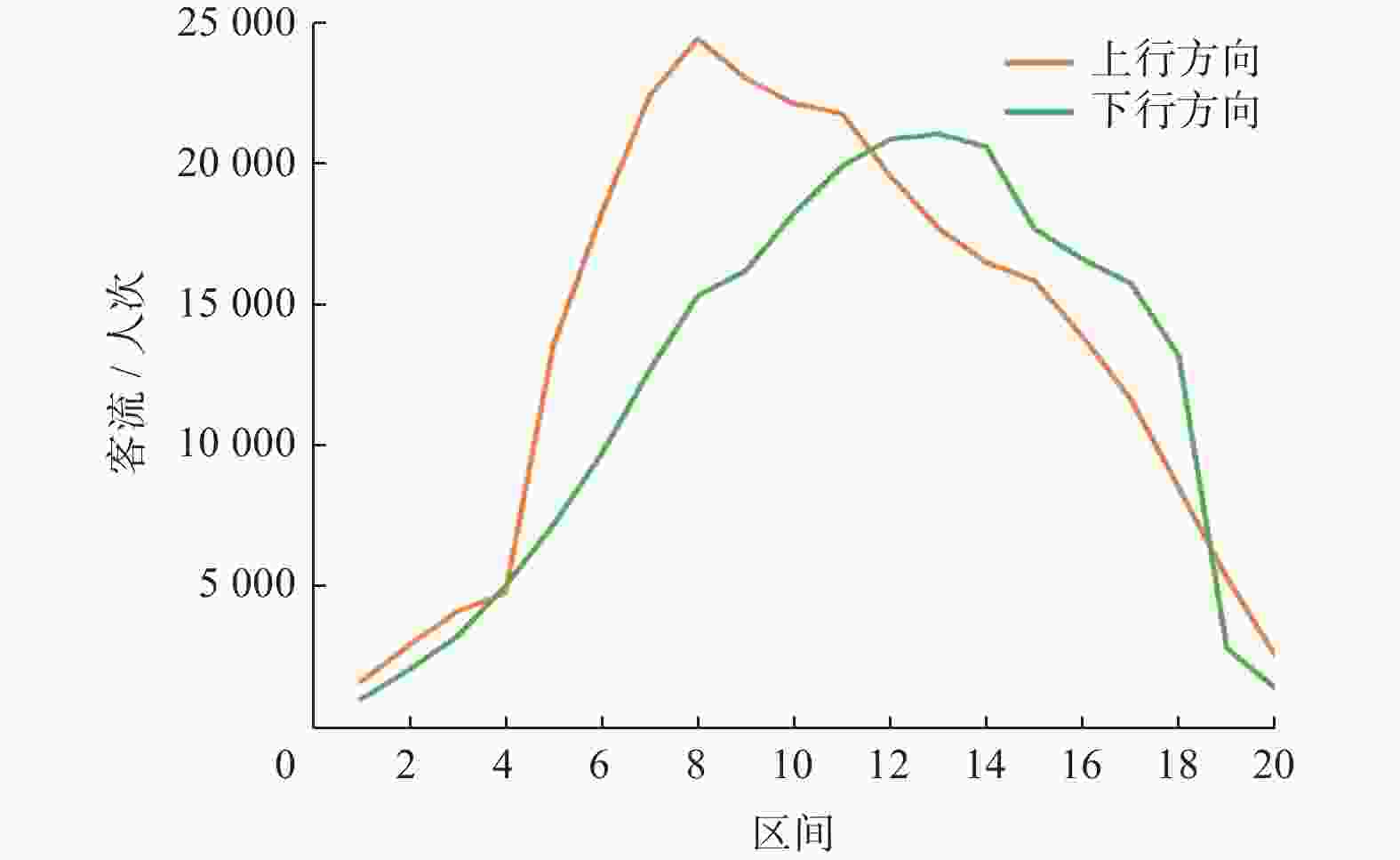
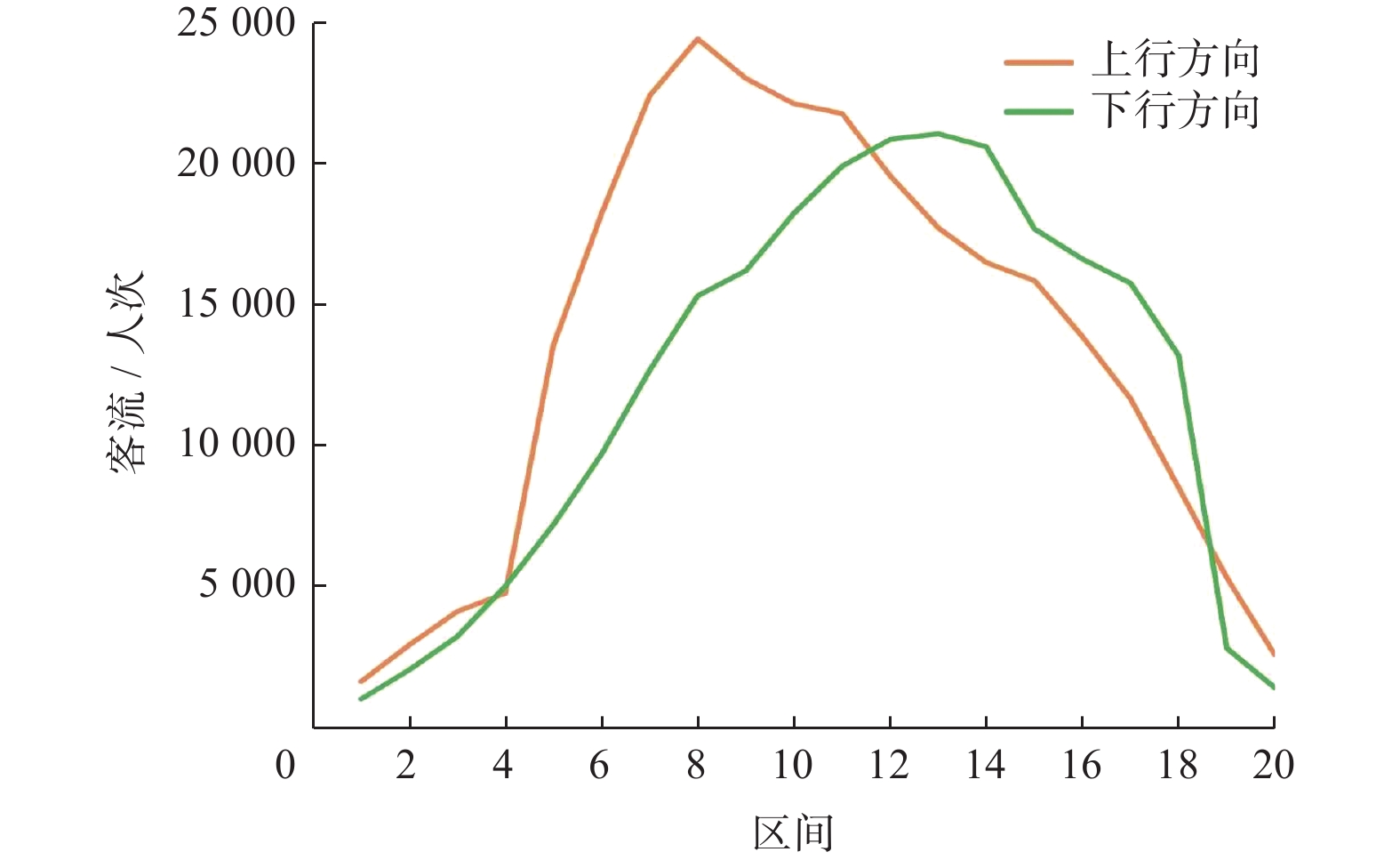
图 5 某时段下各区间的断面客流量分布
Figure 5. Distribution of section passenger flow in each interval during a certain period
表 1 相关参数取值
Table 1. Relevant parameter values
参数 符号 取值 最小发车频率/(对·h−1) $ {f}_{\min } $ 10 最大发车频率/(对·h−1) $ {f}_{\max } $ 25 停站时间/s $ {s}_{j} $ 40 列车折返时间/s $ {t}_{z} $ 100 列车最小编组/节 $ {n}_{\min } $ 4 列车最大编组/节 $ {n}_{\max } $ 8 列车定员数/人 $ C $ 240 可用车辆数/节 $ {V}_{0} $ 250 最大断面满载率 $ {\gamma }_{\max } $ 1.2 最小覆盖区间/个 $ {q}_{\min } $ 5 乘客等待时间费用系数/(元·min−1) $ {\lambda }_{1} $ 0.79 列车走行公里费用系数/(元·(车·km)−1) $ {\lambda }_{2} $ 0.45  下载: 导出CSV
表 2 求解结果
Table 2. Solution results
变量 方案1 方案2 方案3 发车频率/(对·h−1) 24 25 24 大交路列车编组/节 2 3 2 小交路列车编组/节 2 3 4 交路区间 (6,18) (7,12) (6,18) 乘客等待时间成本/元 4203.53 4035.38 4203.53 列车走行公里数成本/元 2009.23 2451.60 2754.00 总成本/元 6212.76 6486.98 6957.53 目标函数值 3106.38 3243.49 3478.77
下载: 导出CSV
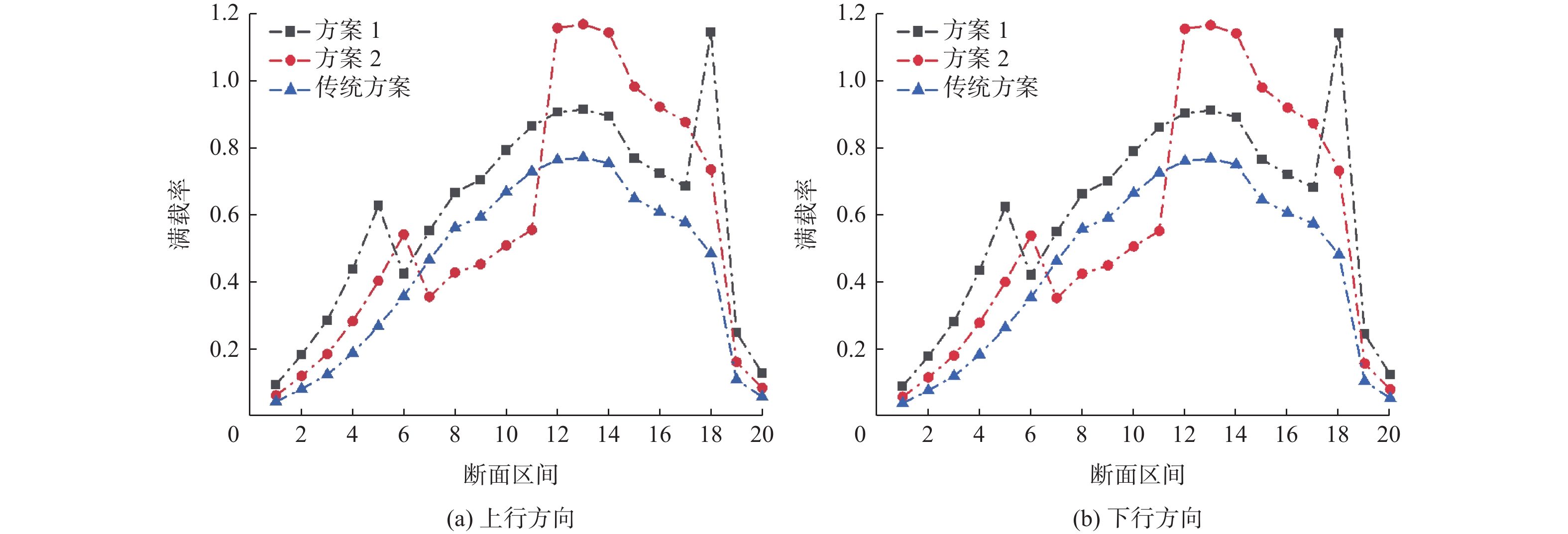
表 3 开行方案对比
Table 3. Comparison of operation schemes
方案 $ f $/(对·h−1) $ {n}_{1} $,$ {n}_{2} $/节 交路区间 乘客等待时间/min 走行公里数/km 运用车辆数/节 运用列车数/列 最大断面满载率 方案1 24 2,2 (6,18) 5320.92 4464.96 138 59 1.178 方案2 25 3,3 (7,12) 5108.08 5448.00 190 58 1.169 方案3 24 2,4 (6,18) 5320.92 6120.00 190 59 1.178 传统线路 19 6 — 6721.16 6673.56 209 34 0.892
下载: 导出CSV
-
[1] 王磊, 李思杰, 刘志钢, 等. 基于供需匹配的城市轨道交通大小交路开行方案优化[J] . 铁道运输与经济, 2023, 45(6): 125 − 131. doi: 10.16668/j.cnki.issn.1003-1421.2023.06.18 [2] 许得杰, 毛保华, 陈绍宽, 等. 考虑开行比例的大小交路列车开行方案优化[J] . 交通运输工程学报, 2021, 21(2): 173 − 186. doi: 10.19818/j.cnki.1671-1637.2021.02.015 [3] 陈维亚, 章雍, 陈鑫, 等. 城市轨道交通大小交路开行方案与多站联合限流协同优化研究[J] . 交通运输系统工程与信息, 2019, 19(5): 177 − 184. [4] 张海, 吕苗苗, 倪少权. 基于非均匀发车间隔的大小交路时刻表优化模型[J] . 交通运输系统工程与信息, 2022, 22(6): 224 − 233. [5] Pan H C, Yang L X, Liang Z. Demand-oriented integration optimization of train timetabling and rolling stock circulation planning with flexible train compositions: a column-generation-based approach[J] . European Journal of Operational Research, 2023, 305(1): 184 − 206. doi: 10.1016/j.ejor.2022.05.039 [6] 周厚盛, 戚建国, 杨立兴, 等. 基于灵活编组的城轨车底运用计划及鲁棒客流控制策略[J] . 控制与决策, 2023, 38(9): 2663 − 2671. doi: 10.13195/j.kzyjc.2021.2054 [7] 邰国璇, 黄友能, 李春驰, 等. 基于灵活编组的市域快轨时刻表优化方法研究[J] . 交通运输系统工程与信息, 2023, 23(3): 195 − 203. [8] 禹丹丹, 韩宝明, 张琦, 等. 基于灵活编组的轨道交通列车开行方案优化方法[J] . 北京交通大学学报, 2015, 39(6): 21 − 31. [9] 李伟, 陈思倩, 周珺, 等. 在线编解模式下城市轨道交通列车灵活编组开行方案优化方法[J] . 中国铁道科学, 2024, 45(1): 203 − 214. doi: 10.3969/j.issn.1001-4632.2024.01.19 [10] 袁也, 徐皓, 卢学永, 等. 基于量子计算的灵活编组列车大小交路混合运行优化方法[J] . 山东科学, 2024, 37(6): 94 − 103. doi: 10.3976/j.issn.1002-4026.20240003 -

 下载:
下载:

 点击查看大图

计量
- 文章访问数: 195
- HTML全文浏览量: 124
- PDF下载量: 43
- 被引次数: 0
