




Research on optimization of flexible grouping scheme of urban rail transit trains for passenger demand
-
摘要: 针对城市轨道交通客流需求变化,提出一种在线灵活编组列车开行方案优化方法。以高峰小时客流时空不均衡的双向线路为研究对象,考虑线路联挂解编作业条件,以最小化总能耗费用、固定使用成本和运能运量不匹配惩罚成本为目标,构建混合整数规划模型,并通过Gurobi求解。以某地铁线路为例验证模型有效性。结果表明,灵活编组模式能适应客流分布,降低运营成本,提升运力资源利用效率,可满足乘客出行需求。Abstract: To address changes in urban rail transit passenger demand, an online optimization method for train operation schemes with flexible formation was proposed. Bidirectional lines with unbalanced passenger flow during peak hours were taken as the research object. Considering the operational conditions for train coupling and decoupling along the line, a mixed integer programming model was formulated to minimize total energy consumption costs, fixed usage costs, and penalties for mismatches between transport capacity and passenger demand, and the model was solved using Gurobi. The model's effectiveness was verified through a case study of a metro line. The result demonstrates that the flexible train formation mode can adapt to passenger flow distribution, reduce operational costs, enhance the utilization efficiency of transport resources, and meet passenger travel demand.
-
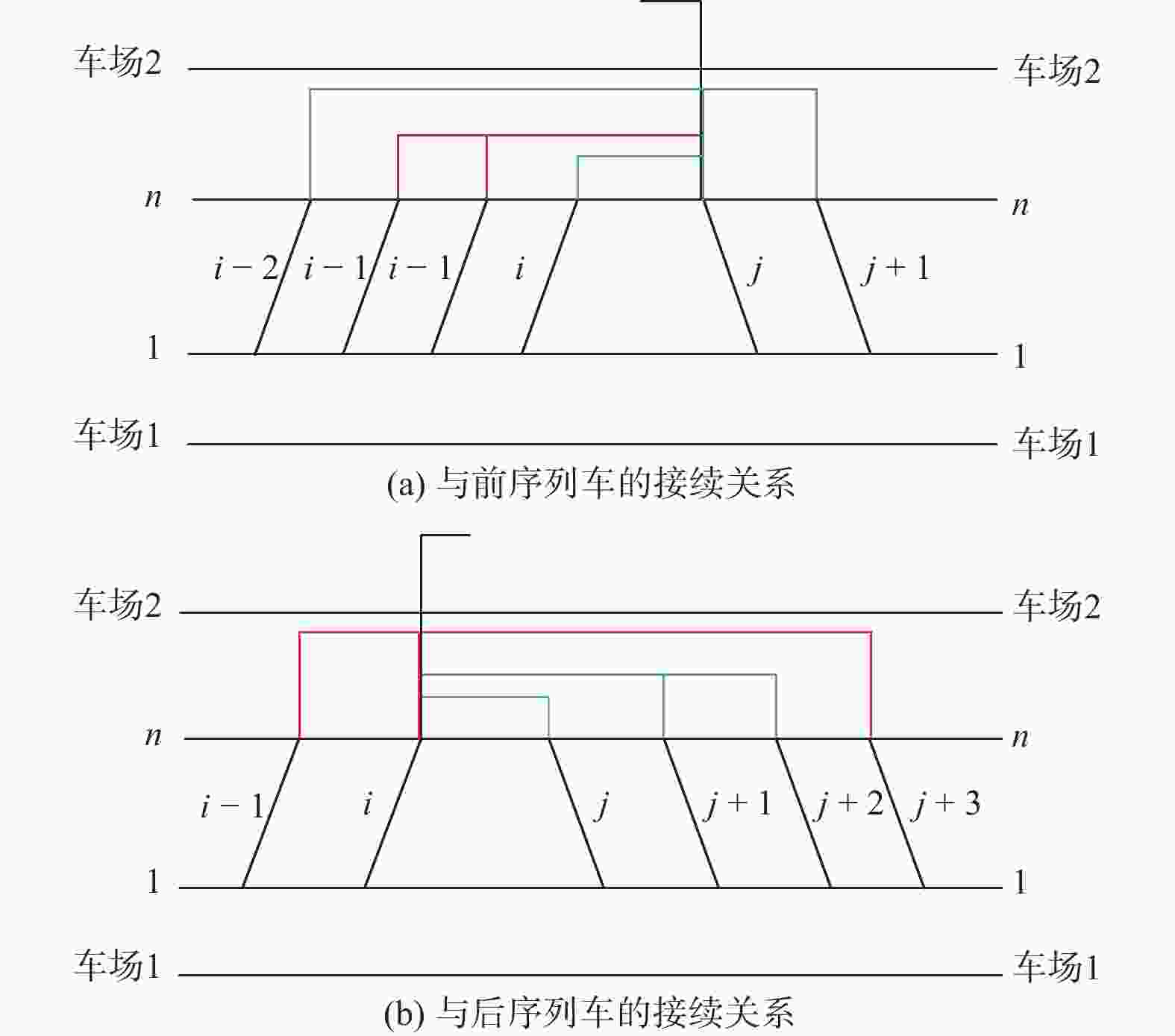
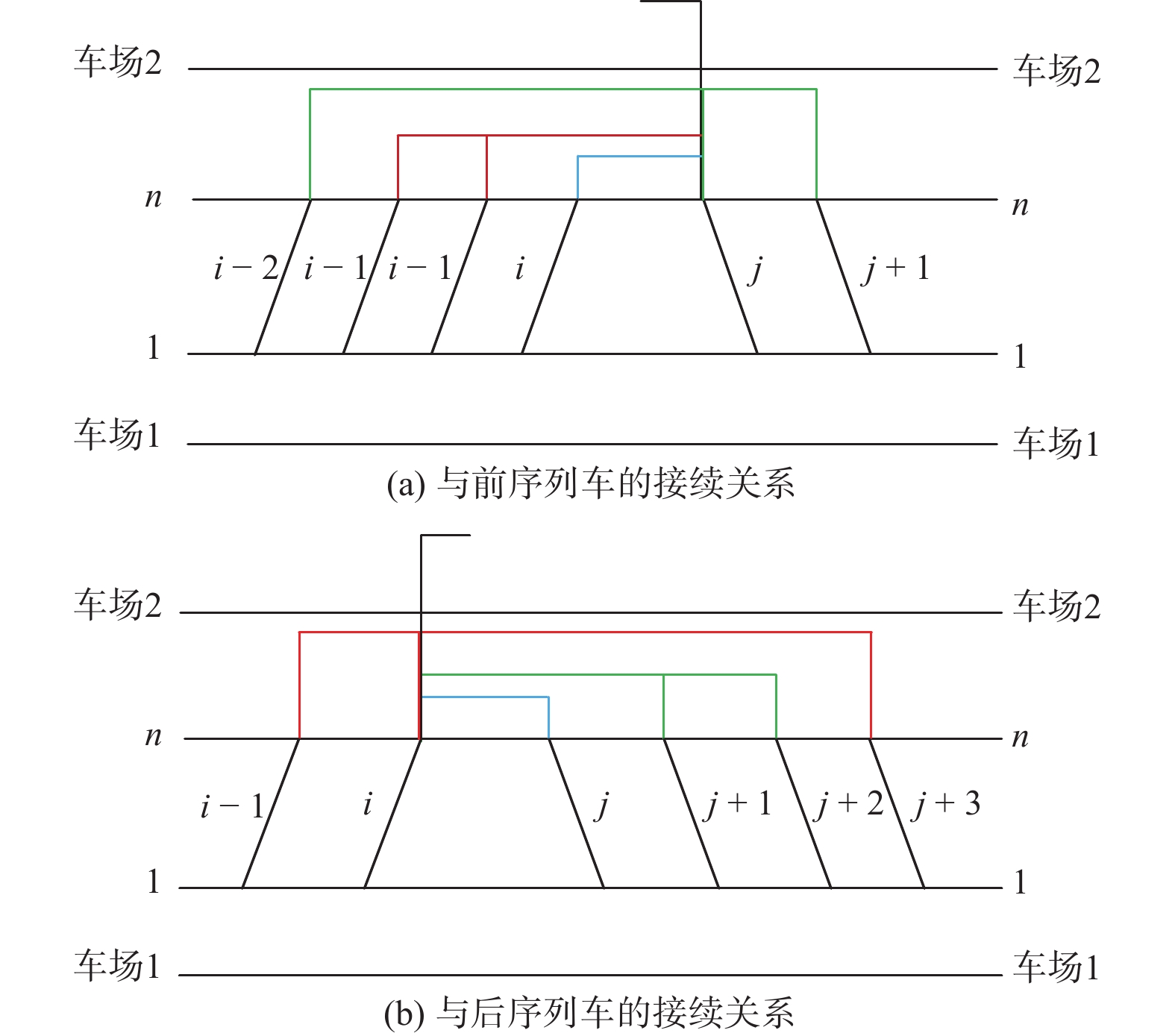
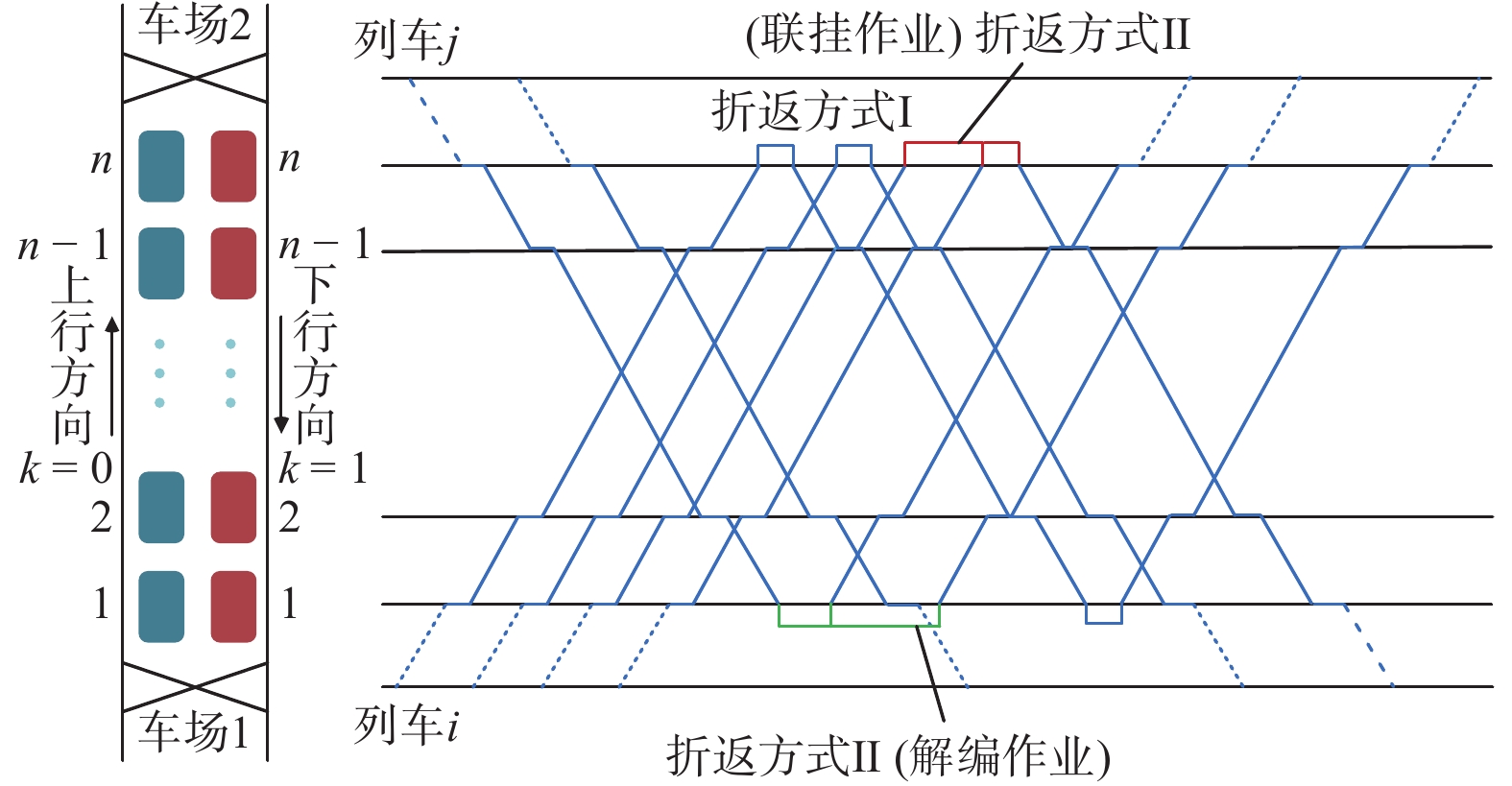
图 2 联挂解编作业车辆数平衡示意图
Figure 2. Diagram of vehicle number balance for decoupling and coupling operations
表 1 参数取值表
Table 1. Parameter value table
参数 符号 取值 最小折返时间/min $ {r}_{{\mathrm{min}}} $ 2 最大折返时间/min $ {r}_{{\mathrm{max}}} $ 12 最短联挂/解编作业时间/min $ {t}_{{\mathrm{min}}} $ 10 编组单元包含的车辆数 $ \varphi $ 3 编组单元额定载客人数 $ \tau $ 2328 单位列车牵引能耗费用/(元·km−1) $ {Q}_{1} $ 2[19] 单位列车行驶每公里设施设备
使用能耗成本/(元·km−1)$ {Q}_{2} $ 0.45[19] 每节车厢平均固定使用成本/元 $ {Q}_{3} $ 2000 [19]运能运量不匹配惩罚费用系数/(元·人−1) $ {\text{Q}}_{4} $ 满载率≤ 1 时,取 1000
满载率> 1 时,取5000 每单元列车空车质量/kg $ {M}_{1} $ 100000 单位乘客质量/kg $ {M}_{2} $ 50 最大折返能力 $ {C}^{{\mathrm{turn}}} $ 2 列 最大满载率 $ \omega $ 1.3 $ {Z}_{1} $,$ {Z}_{2} $,$ {Z}_{3} $ 权重系数 $ {\gamma }_{1} $,$ {\gamma }_{2} $,$ {\gamma }_{3} $ 1/3,1/3,1/3  下载: 导出CSV
表 2 各编组模式下运营效果对比
Table 2. Comparison of operational effectiveness under various formation modes
参数 固定编组 大小编组 灵活编组 购置车辆数 84 84 78 运营能耗费用/元 329834.2 308621.1 286164.2 列车平均使用固定成本/元 168000 168000 156000 运能运量不匹配惩罚成本/元 362251.4 314461.4 277345.1 目标函数值/元 285975.6 262228.1 238046.7
下载: 导出CSV
表 3 不同权重系数下各方案结果对比
Table 3. Comparison of schemes with different weighting coefficients
方案 权重系数 运营能耗费用/元 列车平均使用固定成本/元 运能运量不匹配惩罚成本/元 1 $ \left(\dfrac{2}{4},\dfrac{1}{4},\dfrac{1}{4}\right) $ 273321.9 144000 307370.9 2 $ \left(\dfrac{1}{4},\dfrac{2}{4},\dfrac{1}{4}\right) $ 281523.3 138000 317370.9 3 $ \left(\dfrac{1}{4},\dfrac{1}{4},\dfrac{2}{4}\right) $ 307952.2 168000 256562.1 4 $ \left(\dfrac{1}{3},\dfrac{1}{3},\dfrac{1}{3}\right) $ 288368.8 156000 277345.1
下载: 导出CSV
-
[1] 郑亚珺. 城市轨道交通列车编组方案优化研究[D] . 北京: 北京交通大学, 2014. [2] 陈浩然. 用于城市轨道交通的小编组、高密度列车运行方案[J] . 中国铁路, 2001(5): 44 − 46. doi: 10.19549/j.issn.1001-683x.2001.05.015 [3] 李笑桃, 罗昌权, 王睿. 大小编组模式下城际铁路列车开行方案优化研究[J] . 铁道运输与经济, 2023, 45(7): 8 − 13. doi: 10.16668/j.cnki.issn.1003-1421.2023.07.02 [4] 徐轲非. 考虑多编组的城市轨道交通Y型线路列车开行方案研究[D] . 北京: 北京交通大学, 2021. [5] Cadarso L, Marín á. Integration of timetable planning and rolling stock in rapid transit networks[J] . Annals of Operations Research, 2012, 199(1): 113 − 135. doi: 10.1007/s10479-011-0978-0 [6] 黄文杰, 陈志, 梁汝军, 等. 基于无线通信的地铁列车在线灵活编组技术研究[J] . 城市轨道交通研究, 2024, 27(5): 57 − 62. doi: 10.16037/j.1007-869x.2024.05.012 [7] 王冬海, 黄柒光. 列车灵活编组在城市轨道交通全自动运行线路中的应用[J] . 城市轨道交通研究, 2019, 22(增刊2): 102 − 105. doi: 10.16037/j.1007-869x.2019.S2.028 [8] 周厚盛, 戚建国, 杨立兴, 等. 基于灵活编组的城轨车底运用计划及鲁棒客流控制策略[J] . 控制与决策, 2023, 38(9): 2663 − 2671. doi: 10.13195/j.kzyjc.2021.2054 [9] Pan H C, Yang L X, Liang Z. Demand-oriented integration optimization of train timetabling and rolling stock circulation planning with flexible train compositions: a column-generation-based approach[J] . European Journal of Operational Research, 2023, 305(1): 184 − 206. doi: 10.1016/j.ejor.2022.05.039 [10] Zhao Y Q, Li D W, Yin Y H. Integrated optimization of train formation plan and rolling stock scheduling under Time-dependent demand[J] . Computers & Operations Research, 2023, 150: 106049. doi: 10.1016/j.cor.2022.106049 [11] 李伟, 陈思倩, 周珺, 等. 在线编解模式下城市轨道交通列车灵活编组开行方案优化方法[J] . 中国铁道科学, 2024, 45(1): 203 − 214. doi: 10.3969/j.issn.1001-4632.2024.01.19 [12] Khmelnitsky E. On an optimal control problem of train operation[J] . IEEE Transactions on Automatic Control, 2000, 45(7): 1257 − 1266. doi: 10.1109/9.867018 [13] Tan D, Luo W H, Liu Q. Multi-objective particle swarm optimization algorithm for engineering constrained optimization problems[C] //2009 IEEE International Conference on Granular Computing. Nanchang: IEEE, 2009. DOI: 10.1109/GRC.2009.5255064. [14] Heineken W, Richter M, Birth-Reichert T. Energy-efficient train driving based on optimal control theory[J] . Energies, 2023, 16(18): 6712. DOI: 10.3390/en16186712. [15] 马少坡, 刘炜, 周晓辉, 等. 基于惰行节能规律的列车运行仿真研究[J] . 铁道机车车辆, 2011, 31(3): 25 − 29. doi: 10.3969/j.issn.1008-7842.2011.03.007 [16] 李姗, 苗建瑞, 孟令云, 等. 面向节能的城轨列车区间运行时分优化研究[J] . 铁道科学与工程学报, 2016, 13(8): 1630 − 1635. doi: 10.3969/j.issn.1672-7029.2016.08.027 [17] Chevrier R, Pellegrini P, Rodriguez J. Energy saving in railway timetabling: a bi-objective evolutionary approach for computing alternative running times[J] . Transportation Research Part C: Emerging Technologies, 2013, 37: 20 − 41. doi: 10.1016/j.trc.2013.09.007 [18] 刘海东, 毛保华, 丁勇, 等. 城市轨道交通列车节能问题及方案研究[J] . 交通运输系统工程与信息, 2007, 7(5): 68 − 73. doi: 10.3969/j.issn.1009-6744.2007.05.012 [19] 郜新军. 城市轨道交通系统碳排放评估及集成优化控制方法研究[D] . 北京: 北京交通大学, 2013. -

 下载:

 点击查看大图
计量
- 文章访问数: 12
- HTML全文浏览量: 5
- PDF下载量: 1
- 被引次数: 0
