




Structral design and stiffness modeling analysis of linear drive flexible joint based on magneto-variable stiffness
-
摘要: 针对刚性机械臂环境适应性不足、柔性机械臂力输出有限,以及传统变刚度技术响应慢、刚度变化不连续等问题,设计了基于磁致变刚度的线驱动纯柔性关节以及刚柔耦合关节。首先,建立基于斜链的磁流变模型并分析其强度影响因素。随后,设计以磁流变弹性体为中心体的线驱动纯柔性关节,将其简化为悬臂梁建立刚度模型,并验证模型准确性。实验表明,在磁场强度为40 mT环境下,关节刚度提升33%。其次,设计一种刚柔耦合关节,基于虚功原理建立关节扭矩模型,推导得到关节刚度模型并进行仿真及实验。结果表明,在2 A电流下,关节刚度提升46.4%。对比结果表明,刚柔耦合关节具有更宽广的刚度变化范围。Abstract: To address the problems of limited environmental adaptability of rigid manipulators, limited force output capability of flexible manipulators, and slow response and discontinuous stiffness variation of traditional variable stiffness technologies, a cable-driven pure flexible joint and a rigid-flexible coupling joint based on magnetorheological variable stiffness were designed. First, a magnetorheological elastomer model based on an inclined chain was established, and the factors affecting its strength were analyzed. Then, a cable-driven pure flexible joint with a magnetorheological elastomer as the central body was designed. Its stiffness model was established by simplifying it to a cantilever beam, and the accuracy was verified. The experimental results show that the joint stiffness is increased by 33% at a magnetic field strength of 40 mT. Next, a rigid-flexible coupling joint was designed. Based on the principle of virtual work, a torque model of the joint was established, from which the joint stiffness model was derived, and simulations and experiments were conducted. The results show that the stiffness is increased by 46.4% at a current of 2 A. Comparative results indicate that the rigid-flexible coupling joint has a broader range of stiffness variation.
-
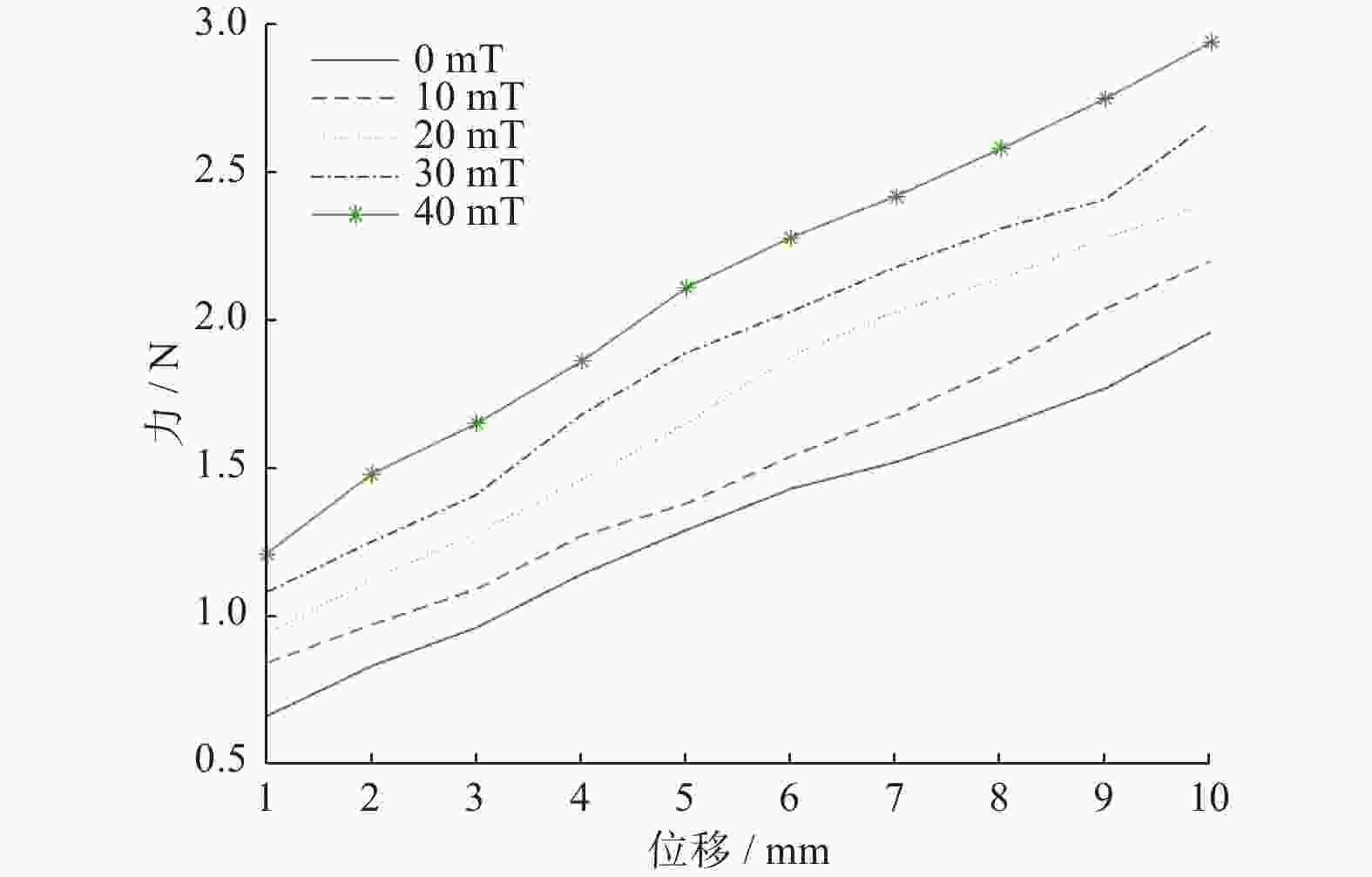
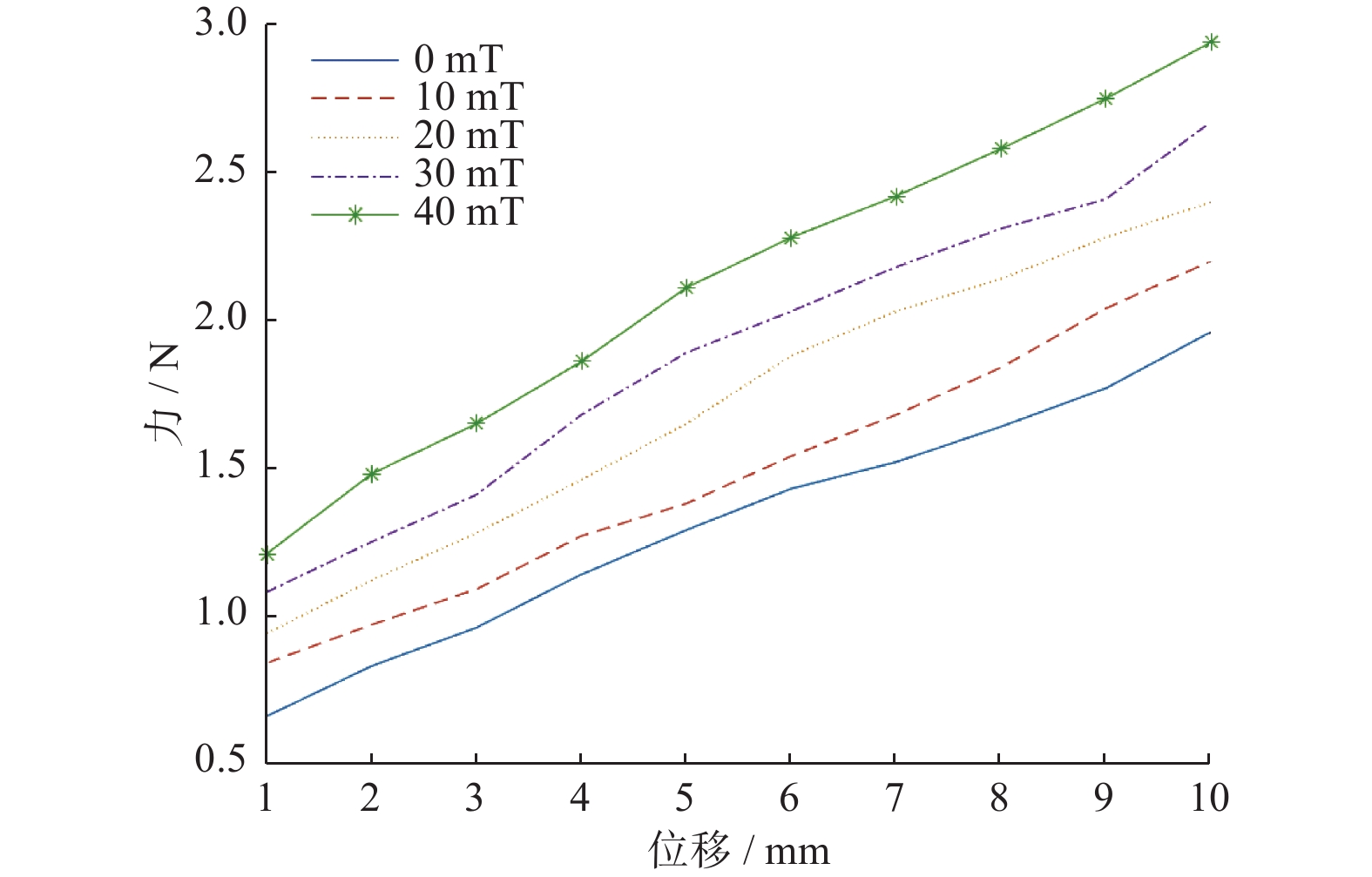
图 6 不同磁场强度下刚度特性
Figure 6. Stiffness characteristics under different magnetic field intensities
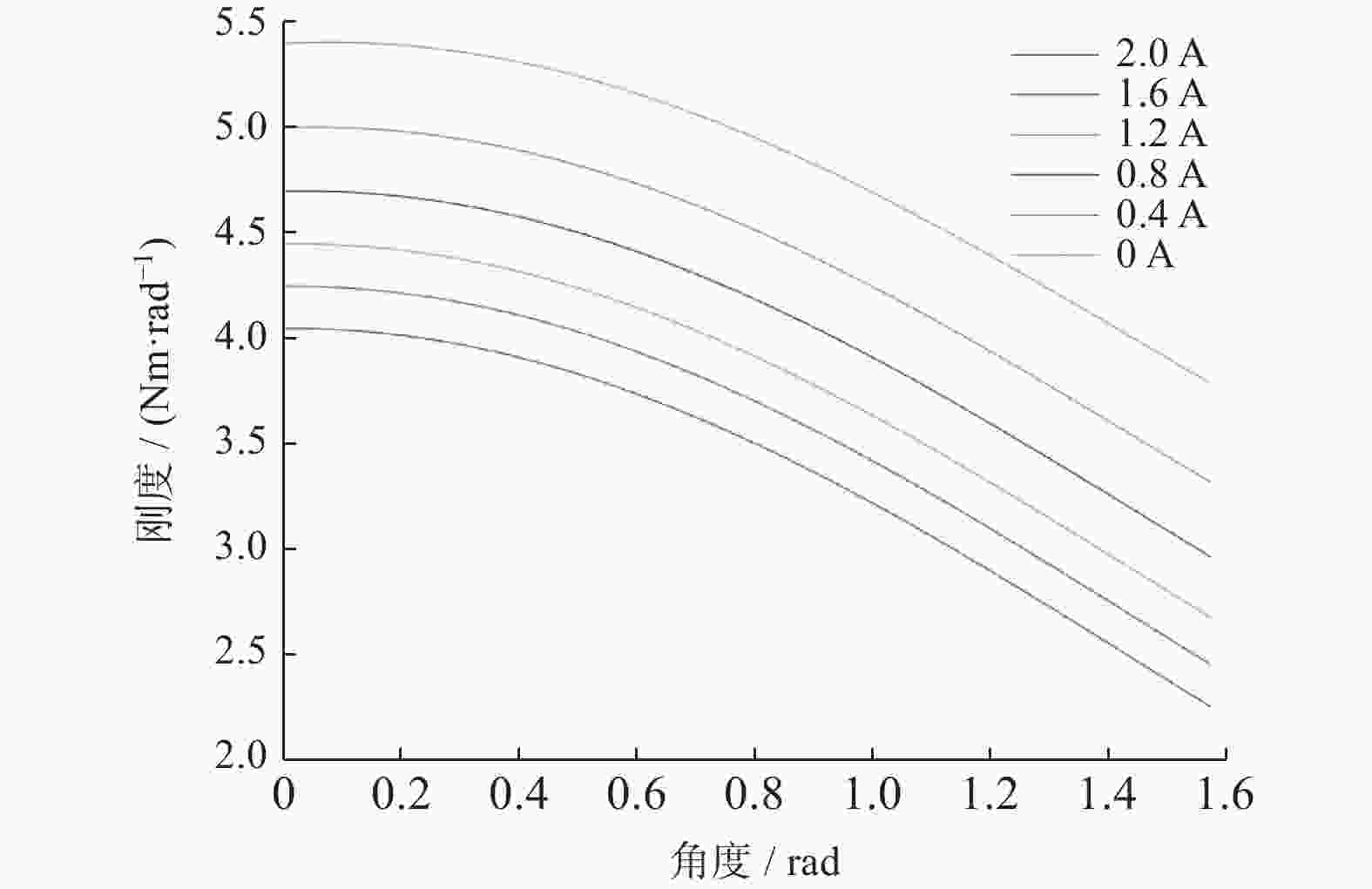
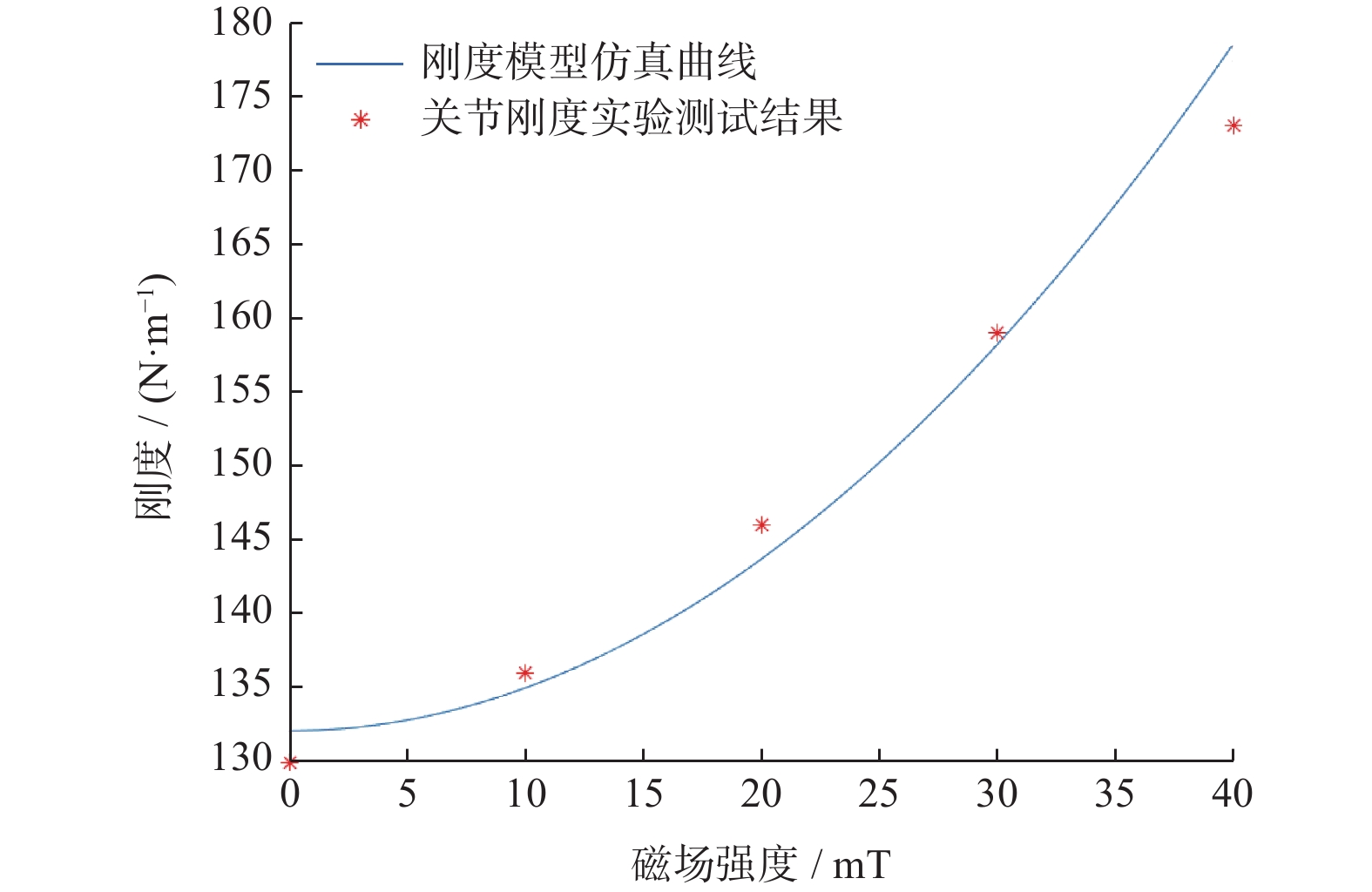
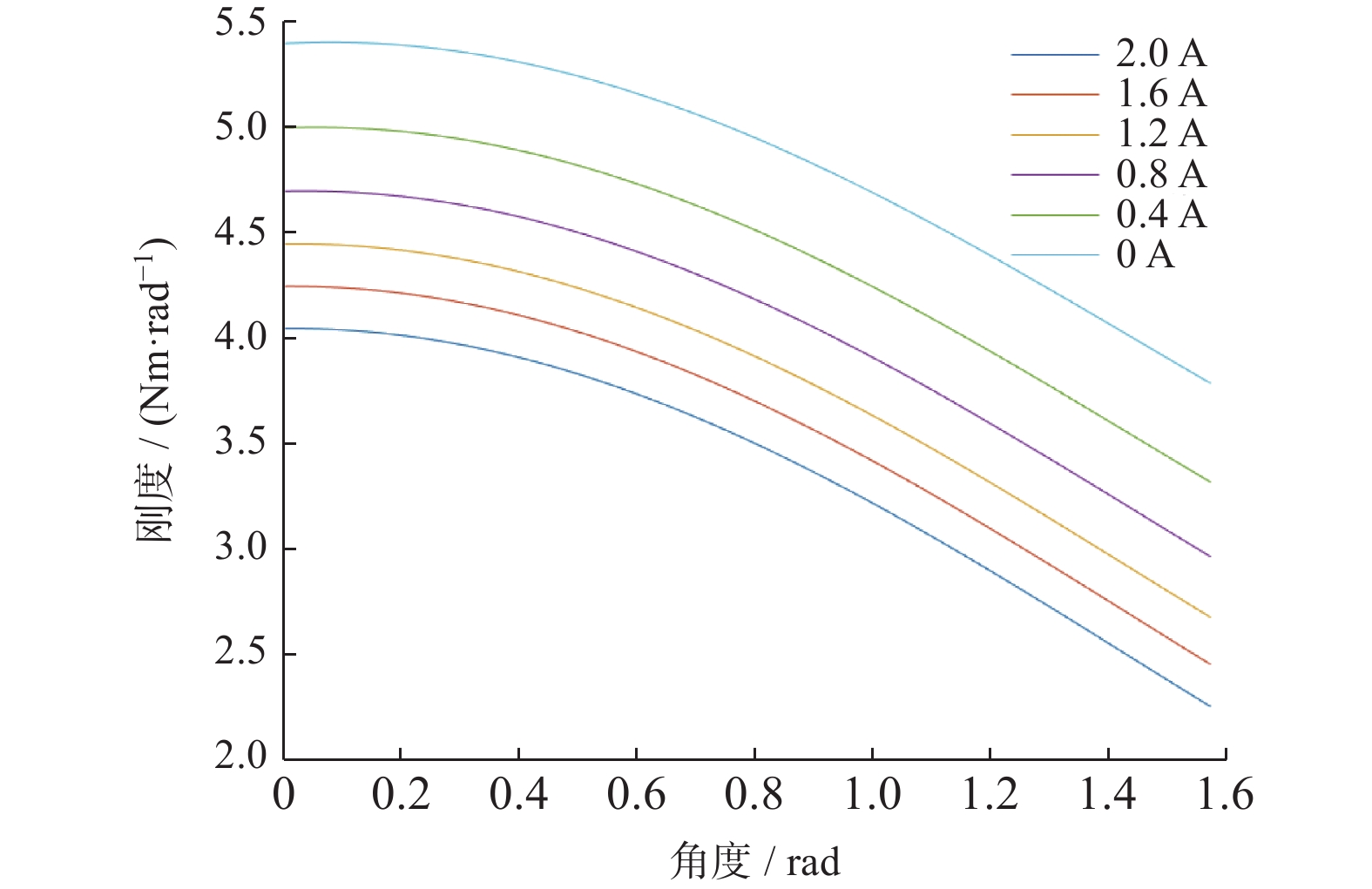
图 12 不同电流下关节刚度仿真
Figure 12. Simulation of joint stiffness under different current currents
-
[1] Fan J Z, Zhang W, Kong P C, et al. Design and dynamic model of a frog-inspired swimming robot powered by pneumatic muscles[J] . Chinese Journal of Mechanical Engineering, 2017, 30(5): 1123 − 1132. doi: 10.1007/s10033-017-0182-5 [2] Ham K, Han J, Park Y J. Soft gripper using variable stiffness mechanism and its application[J] . International Journal of Precision Engineering and Manufacturing, 2018, 19(4): 487 − 494. doi: 10.1007/s12541-018-0059-2 [3] Wang W, Yu C Y, Abrego Serrano P A, et al. Shape memory alloy-based soft finger with changeable bending length using targeted variable stiffness[J] . Soft Robotics, 2020, 7(3): 283 − 291. doi: 10.1089/soro.2018.0166 [4] Krztoń-maziopa A, Ciszewska M, Płocharski J. Electrorheological fluids based on polymer electrolytes[J] . Electrochimica Acta, 2005, 50(19): 3838 − 3842. doi: 10.1016/j.electacta.2005.02.035 [5] Cianchetti M, Ranzani T, Gerboni G, et al. Soft robotics technologies to address shortcomings in today’s minimally invasive surgery: the STIFF-FLOP approach[J] . Soft Robotics, 2014, 1(2): 122 − 131. doi: 10.1089/soro.2014.0001 [6] Perry J C, Rosen J, Burns S. Upper-limb powered exoskeleton design[J] . IEEE/ASME Transactions on Mechatronics, 2007, 12(4): 408 − 417. doi: 10.1109/TMECH.2007.901934 [7] Galloway K C, Becker K P, Phillips B, et al. Soft robotic grippers for biological sampling on deep reefs[J] . Soft Robotics, 2016, 3(1): 23 − 33. doi: 10.1089/soro.2015.0019 [8] Brancadoro M, Manti M, Tognarelli S, et al. Fiber jamming transition as a stiffening mechanism for soft robotics[J] . Soft Robotics, 2020, 7(6): 663 − 674. doi: 10.1089/soro.2019.0034 [9] Fei Y Q, Wang J B, Pang W. A novel fabric-based versatile and stiffness-tunable soft gripper integrating soft pneumatic fingers and wrist[J] . Soft Robotics, 2019, 6(1): 1 − 20. doi: 10.1089/soro.2018.0015 [10] Alambeigi F, Seifabadi R, Armand M. A continuum manipulator with phase changing alloy[C] //Proceedings of 2016 IEEE International Conference on Robotics and Automation (ICRA). Stockholm: IEEE, 2016: 758 − 764. [11] Yang Y, Chen Y H, Li Y T, et al. 3D printing of variable stiffness hyper-redundant robotic arm[C] //2016 IEEE International Conference on Robotics and Automation (ICRA). Stockholm: IEEE, 2016: 3871 − 3877. [12] 李铁风, 李国瑞, 梁艺鸣, 等. 软体机器人结构机理与驱动材料研究综述[J] . 力学学报, 2016, 48(4): 756 − 766. [13] Agafonov A V, Kraev A S, Baranchikov A E, et al. Electrorheological properties of polydimethylsiloxane/TiO2-based composite elastomers[J] . Polymers, 2020, 12(9): 2137 − 2137. doi: 10.3390/polym12092137 [14] Ma N, Yao Y W, Wang Q, et al. Properties and mechanical model of a stiffness tunable viscoelastic damper based on electrorheological elastomers[J] . Smart Materials and Structures, 2020, 29(4): 045041. doi: 10.1088/1361-665X/ab7736 [15] 李特, 崔博尧, 刘海波, 等. 磁致变刚度原理的气动软体致动器设计与试验[J] . 机械工程学报, 2023, 59(3): 1 − 12. doi: 10.3901/JME.2023.03.001 [16] De Falco Manuel J G, Bombard A J F, Weeks E R. Effect of polydispersity in concentrated magnetorheological fluids[J] . Smart Materials and Structures, 2023, 32(4): 045014. doi: 10.1088/1361-665X/acbb47 [17] Liu F, Huang H L, Li B, et al. Design and analysis of a cable-driven rigid–flexible coupling parallel mechanism with variable stiffness[J] . Mechanism and Machine Theory, 2020, 153: 104030. doi: 10.1016/j.mechmachtheory.2020.104030 -

 下载:
下载:

 点击查看大图
图(14)
计量
- 文章访问数: 179
- HTML全文浏览量: 102
- PDF下载量: 32
- 被引次数: 0
