




Research on improvement mechanism of cross-border e-commerce sales performance under COSMO algorithm paradigm
-
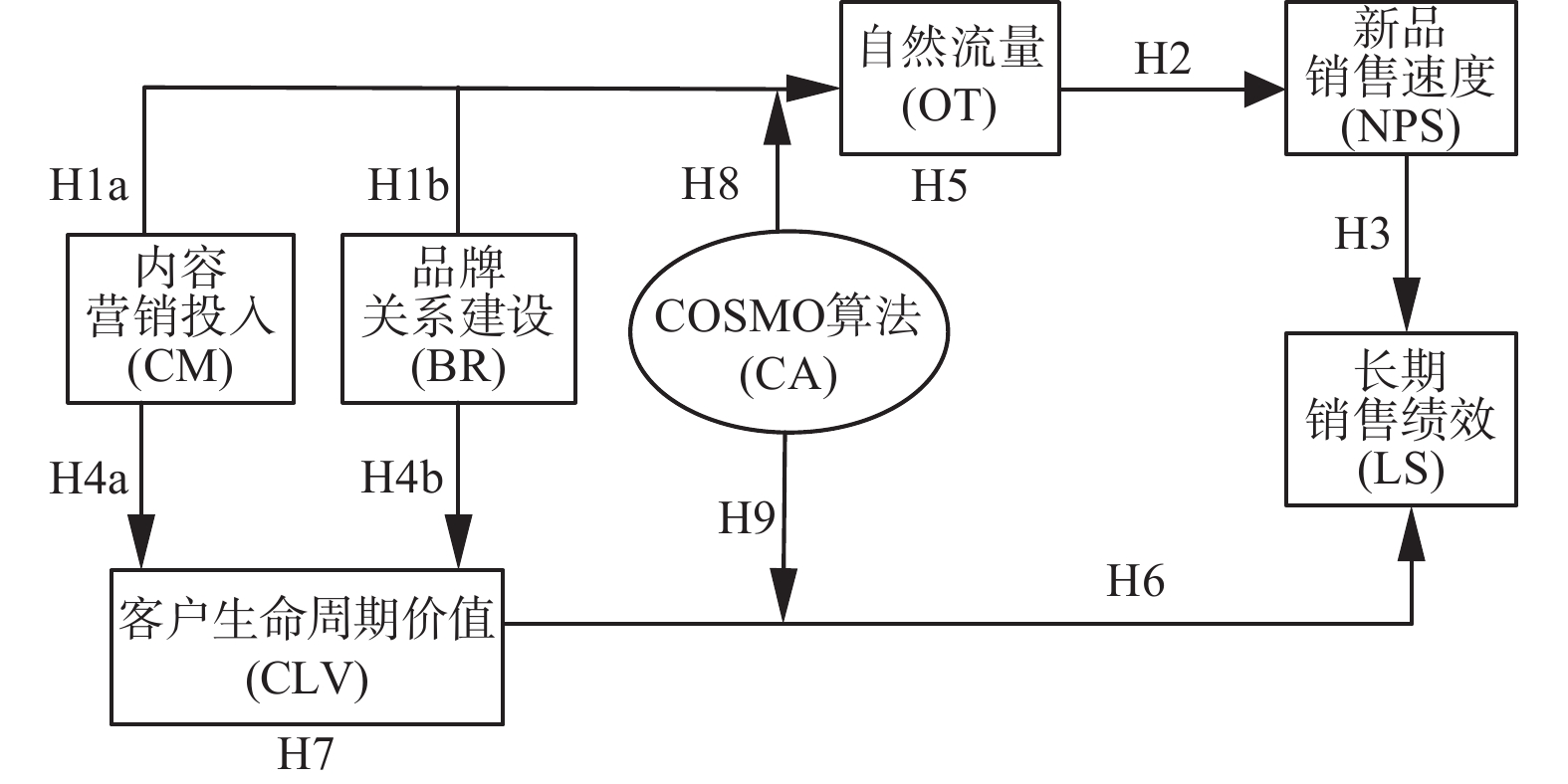
摘要: 针对亚马逊跨境电商在常识知识生成与服务系统(common sense knowledge generation and serving system, COSMO)智能算法迭代下,传统营销理论适配不足、绩效传导机制不清晰等问题,基于信息处理、关系营销与算法赋能理论,以亚马逊美国站跨境电商企业为样本,采用实证方法检验其绩效提升传导路径。结果表明:内容营销投入与品牌关系建设显著正向影响自然流量、新品销售速度及长期销售绩效;自然流量与新品销售速度发挥链式中介作用,客户生命周期价值承担关键中介作用;COSMO算法对核心传导路径具有显著正向调节效应。研究揭示,COSMO算法重塑平台流量分配逻辑,关系导向的内容品牌运营是长效增长核心路径,客户生命周期价值是绩效转化关键中介。研究结果为COSMO算法下跨境电商营销提升机制提供了新思路,为企业智能运营与可持续增长提供了理论与实践参考。Abstract: Addressing the problems of inadequate adaptation of traditional marketing theories and unclear performance transmission mechanisms in Amazon cross-border e-commerce under the iteration of the common sense knowledge generation and serving system (COSMO) intelligent algorithm, performance improvement paths were empirically examined using Amazon US enterprises as samples, based on information processing, relationship marketing and algorithm empowerment theories. The results indicate that content marketing investment and brand relationship construction significantly positively influence organic traffic, new product sales speed, and long-term sales performance; organic traffic and new product sales speed play a chain mediating role, while customer lifetime value acts as a key mediator; and the COSMO algorithm has a significant positive moderating effect on core transmission paths. It is revealed that the COSMO algorithm reshapes the platform traffic allocation logic, relationship-oriented content and brand operations are the core path for long-term growth, and customer lifetime value is the key mediator for performance transformation. These results provide new insights into the marketing improvement mechanism of cross-border e-commerce under the COSMO algorithm, theoretical and practical references for intelligent operation and sustainable growth of enterprises.
-
Key words:
- COSMO algorithm /
- cross-border e-commerce /
- sales performance /
- customer lifetime value
-
表 1 样本描述性统计(N=520)
Table 1. Descriptive statistics of samples (N=520)
变量名称 分类 频数n 百分比/% 变量名称 分类 频数n 百分比/% 企业性质 有限责任公司 328 63.1 运营时长 [1,3] 年 221 42.5 个体工商户 117 22.5 (3,5] 年 178 34.2 股份有限公司 45 8.7 (5,8] 年 92 17.7 合伙企业/外商独资企业 30 5.7 8 年以上 29 5.6 卖家规模 大型(年营收> 5000 万元)168 32.3 注册地区 广东省 156 30.0 中型(1000万元<年营收≤5000万元) 215 41.3 浙江省 114 21.9 小型(年营收≤ 1000 万元)137 26.4 福建省 85 16.3 所属品类 消费电子 135 26.0 其他省份 (含直辖市) 165 31.8 家居用品 128 24.6 运营模式 平台型(仅入驻亚马逊) 386 74.2 服装配饰 132 25.4 平台 + 独立站双线运营 134 25.8 美妆个护 125 24.0 品牌授权 有品牌注册/授权 396 76.2 无品牌授权(白牌运营) 124 23.8  下载: 导出CSV
表 2 KMO 和巴特利特检验表
Table 2. KMO and Bartlett's test
检验方法 参数 整体 CM BR OT NPS CLV LS KMO值 — 0.946 0.872 0.868 0.885 0.85 0.893 0.876 巴特利特球形检验 Χ2 19327.654 2863.419 1752.836 2145.728 1589.364 2378.591 2378.591 Df 1035 15 6 3 3 6 3 P值 0.000 0.000 0.000 0.000 0.000 0.000 0.000
下载: 导出CSV
表 3 回归分析显著性检验结果
Table 3. Results of significance test for regression analysis
假设 自变量 因变量 未标准化系数β 标准化系数β R2 F值 显著性 H1a CM OT 0.719 0.364 0.457 67.824 *** H1b BR OT 0.264 0.210 0.457 39.060 *** H2 OT NPS 0.583 0.297 0.385 52.193 *** H3 NPS LS 0.491 0.243 0.398 54.726 *** H4a CM CLV 0.765 0.387 0.483 73.451 *** H4b BR CLV 0.249 0.200 0.483 30.415 *** H6 CLV LS 0.702 0.356 0.462 69.138 ***
下载: 导出CSV
表 4 中介效应与链式中介效应检验结果
Table 4. Test results of mediating effect and chain mediating effect
假设 中介效应 效应类型 Effect SE 95%置信区间 显著性 H5 CM & BR→OT→NPS→LS 链式中介效应 0.027 0.008 [0.015,0.042] *** H7 CM & BR→CLV→LS 中介效应 0.138 0.019 [0.102,0.175] *** — CM & BR→LS 直接效应 0.215 0.024 [0.168,0.262] *** — CM & BR→LS 总效应 0.380 0.031 [0.319,0.441] ***
下载: 导出CSV
表 5 调节效应检验结果
Table 5. Results of moderating effect test
调节变量 交互项 因变量 未标准化系数β 标准化系数β R²提高值 F值 显著性 CA (CM & BR) × CA OT 0.421 0.213 0.042 34.480 *** CA CLV × CA LS 0.390 0.197 0.038 28.580 ***
下载: 导出CSV
-
[1] 张双伶, 夏娟. 数智化转型、创新驱动与零售企业效率提升[J] . 商业经济研究, 2024(8): 169 − 172. doi: 10.3969/j.issn.1002-5863.2024.08.041 [2] 谢康, 夏正豪, 肖静华. 大数据成为现实生产要素的企业实现机制: 产品创新视角[J] . 中国工业经济, 2020(5): 42 − 60. [3] 张小英. A9算法视角下亚马逊卖家商品关键词优化策略研究[J] . 销售与管理, 2022(16): 73 − 75. [4] Brown T B, Mann B, Ryder N, et al. Language models are few-shot learners[C] //The 34th International Conference on Neural Information Processing Systems. Vancouver: Curran Associates Inc, 2020: 159. [5] Yu C L, Liu X, Maia J, et al. COSMO: a large-scale e-commerce common sense knowledge generation and serving system at amazon[C] //Companion of the 2024 International Conference on Management of Data. Santiago: ACM, 2024: 148 − 160. [6] Yu C L, Wang W Q, Liu X, et al. FolkScope: intention knowledge graph construction for e-commerce commonsense discovery[C] //Findings of the Association for Computational Linguistics: ACL 2023. Toronto: ACL, 2023: 1173 − 1191. [7] Shannon C E. A mathematical theory of communication[J] . Bell System Technical Journal, 1948, 27(4): 623 − 656. doi: 10.1002/j.1538-7305.1948.tb00917.x [8] Liu P, Yuan L, Liu Z Y, et al. Shaping innovation normative pressure: how algorithmic management drives employee innovation[J] . Leadership & Organization Development Journal, 2025, 46(5): 649 − 673. doi: 10.1108/LODJ-02-2025-0142 [9] Danneels E. The dynamics of product innovation and firm competences[J] . Strategic Management Journal, 2002, 23(12): 1095 − 1121. doi: 10.1002/smj.275 [10] Morgan R M, Hunt S D. The commitment-trust theory of relationship marketing[J] . Journal of Marketing, 1994, 58(3): 20 − 38. doi: 10.1177/002224299405800302 [11] Buerke A, Straatmann T, Lin-hi N, et al. Consumer awareness and sustainability-focused value orientation as motivating factors of responsible consumer behavior[J] . Review of Managerial Science, 2017, 11(4): 959 − 991. doi: 10.1007/s11846-016-0211-2 [12] Lin M M, Jeong Y M, Zhang Y D, et al. Enhancing customer loyalty in e-commerce: the role of personalization recommendation systems and flow state[J] . Journal of the Korea Society of Computer and Information, 2024, 29(6): 223 − 233. [13] Khaled O, Habib S, Adeeb D, et al. Enhancing knowledge graph embeddings for improved link prediction using Graph neural networks[J] . Knowledge and Information Systems, 2026, 68(1): 45. doi: 10.1007/s10115-025-02619-8 [14] Gummesson E. Total relationship marketing: experimenting with a synthesis of research frontiers[J] . Australasian Marketing Journal, 1999, 7(1): 72 − 85. doi: 10.1016/S1441-3582(99)70204-1 [15] Essiz O, Yurteri S, Mandrik C, et al. Exploring the value-action gap in green consumption: roles of risk aversion, subjective knowledge, and gender differences[J] . Journal of Global Marketing, 2023, 36(1): 67 − 92. doi: 10.1080/08911762.2022.2116376 [16] Ru X J, Liu L, Chen M. Algorithmic empowerment and its impact on circular economy participation: an empirical study based on human-machine collaborative decision-making mechanisms[J] . Journal of Theoretical and Applied Electronic Commerce Research, 2025, 20(4): 353. doi: 10.3390/jtaer20040353 [17] Hanssens D M, Pauwels K H. Demonstrating the value of marketing[J] . Journal of Marketing, 2016, 80(6): 173 − 190. [18] Palmatier R W, Dant R P, Grewal D, et al. Factors influencing the effectiveness of relationship marketing: a Meta-analysis[J] . Journal of Marketing, 2006, 70(4): 136 − 153. [19] Gupta S, & Lehmann D R. Customers as assets[J] . Journal of Interactive Marketing, 2003, 17(1): 9 − 24. -

 下载:
下载:

 点击查看大图
计量
- 文章访问数: 182
- HTML全文浏览量: 107
- PDF下载量: 36
- 被引次数: 0
