




Design and task trajectory planning of an air duct sealant application robot
-
摘要: 中央空调通风管道接缝处的密封胶条在长期使用过程中会变得松散、容易脱落,导致风管漏风,进而影响送风质量。针对该问题,研发一种用于中央空调风管补胶维护的机器人。设计机器人的整体结构,建立执行模块的运动学模型,并使用Matlab软件分析可达工作空间。按照风管补胶作业要求,为执行模块设计插补算法及仿真验证。最后,开展补胶实验,确定系统的最优作业参数为:丝杆电机速度 3 mm/s,末端执行器移动速度 42.2 mm/s。实际作业表明,在该参数下,胶条尺寸均匀、外观光滑,直角拐点处无断裂或堆积现象,且与风管表面黏结牢固,验证了机器人结构设计与轨迹规划的合理性及有效性。Abstract: During the long-term use of central air conditioning ventilation ducts, the sealing strips at duct joints become loose and prone to falling off, causing air leakage in the ducts and affecting the quality of air delivery. To address this issue, a robot for sealant application and maintenance of central air conditioning ducts was developed. The overall structure of the robot was designed, and the kinematic model of the execution module was established. Matlab software was used to analyze the reachable workspace of the end effector module. Subsequently, an interpolation algorithm for the end effector module was designed and verified through simulation to meet the requirements of duct sealing operations. Finally, sealing experiments were conducted, and the optimal operating parameters were determined as follows: a screw motor speed of 3 mm/s and an end effector moving speed of 42.2 mm/s. Practical operation shows that at these parameters, the sealant strip is uniform in dimensions and smooth in appearance, with no breakage or accumulation at right-angle corners, and bonds firmly to the duct surface. This validates the rationality and effectiveness of the robot's structural design and trajectory planning.
-
Key words:
- duct robot /
- trajectory planning /
- simulation analysis /
- experimental validation
-
表 1 风管机器人结构参数与性能指标
Table 1. Design indicators for duct robots
参数 数值 机器人本体质量/kg 20 机器人外形尺寸(长 × 宽 × 高)/( mm × mm × mm) 500 × 300 × 250 工作时行走速度/( m·min−1) 0 ~ 6 爬坡性能/(°) 0 ~ 15  下载: 导出CSV
表 2 执行模块D-H参数
Table 2. Execution mechanism D-H parameters
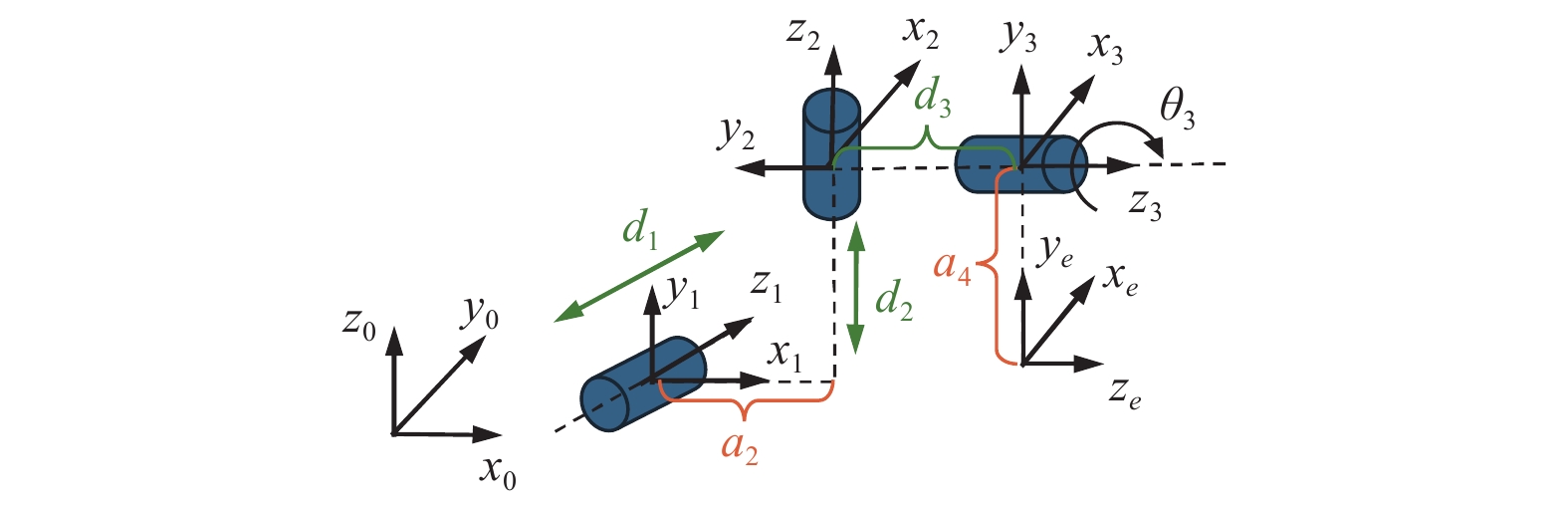
连杆i $ {\alpha }_{i-1} $ $ {a}_{i-1} $ $ {d}_{i} $ $ {\theta }_{i} $ 1 $ -2/{\text{π}} $ 0 $ {d}_{1} $ 0 2 $ 2/{\text{π}} $ $ {a}_{1} $ $ {d}_{2} $ $ 2/{\text{π}} $ 3 $ 2/{\text{π}} $ 0 $ {d}_{3} $ $ {\theta }_{3} $ 4 0 $ {a}_{3} $ 0 0
下载: 导出CSV
表 3 末端执行器移动速度
Table 3. Movement speed of end effector
组别 v1/(mm·s−1) Q/(mm3·s−1) v2/(mm·s−1) 1 1.0 1520.5 16.4 2 2.0 3041.1 31.7 3 3.0 4561.6 47.5 4 4.0 6082.1 63.4 5 5.0 7602.7 79.2 6 6.0 9123.2 95.0
下载: 导出CSV
表 4 补胶实验
Table 4. Glue filling experiment
单位:mm/s 组别 v1 v2-1 v2-2 v2-3 a 1.0 12.7 14.1 16.4 b 2.0 25.3 28.2 31.7 c 3.0 38.0 42.2 47.5 d 4.0 50.7 56.3 63.4 e 5.0 63.4 70.4 79.2 f 6.0 76.0 84.5 95.0
下载: 导出CSV
-
[1] 中国建筑节能协会, 重庆大学城乡建设与发展研究院. 中国建筑能耗与碳排放研究报告(2023年)[J] . 建筑, 2024(2): 46−59. [2] 尹丽萍. 优化中央空调系统实现节能降耗[J] . 中国设备工程, 2022(13): 112 − 114. doi: 10.3969/j.issn.1671-0711.2022.13.051 [3] Ildiri N, Biesiada E, Facchinetti T, et al. Impacts of HVAC cleaning on energy consumption and supply airflow: a multi-climate evaluation[J] . Energy and Buildings, 2025, 328: 115147. doi: 10.1016/j.enbuild.2024.115147 [4] Zhai Z Q, Johnson S N. Full-scale laboratory test on energy dependence on pressure drops in HVAC systems[J] . Procedia Engineering, 2017, 205: 2133 − 2140. doi: 10.1016/j.proeng.2017.10.138 [5] Meng C, Wang Q Q, Song Y H, et al. Experimental study on both cleaning effect and motion performance of the duct-cleaning robot[J] . Sustainable Cities and Society, 2015, 14: 64 − 69. doi: 10.1016/j.scs.2014.07.005 [6] 王聪, 孙炜, 卜德旭, 等. 基于惯性导航与立体视觉的风管清扫机器人同时定位与地图创建方法[J] . 机械工程学报, 2013, 49(23): 59 − 67. doi: 10.3901/JME.2013.23.059 [7] Yi S, Noh E, Hong S. Development of a CNN-based cross point detection algorithm for an air duct cleaning robot[J] . Journal of the Korea Academia-Industrial Cooperation Society, 2020, 21(8): 1 − 8. [8] Koledoye M A, De Martini D, Carvani M, et al. Design of a mobile robot for air ducts exploration[J] . Robotics, 2017, 6(4): 26. doi: 10.3390/robotics6040026 [9] Jeon S W, Jeong W, Park D, et al. Design of an intelligent duct cleaning robot with force compliant brush[C] //Proceedings of the 12th International Conference on Control, Automation and Systems. Jeju: IEEE, 2012: 2033 − 2037. [10] 李恒武. 一种自适应型空调管道清洗机器人的结构研制与运动分析[D] . 武汉: 武汉理工大学, 2011. [11] Wang Y, Zhang J H. Autonomous air duct cleaning robot system[C] //Proceedings of the 49th IEEE International Midwest Symposium on Circuits and Systems. San Juan: IEEE, 2006: 510 − 513. [12] 常祺, 闫宏伟, 牛海龙, 等. 管道巡检清理机器人管内运动分析[J] . 机械传动, 2024, 48(10): 155 − 163. doi: 10.16578/j.issn.1004.2539.2024.10.019 [13] 刘莹, 申超, 邵泉钢, 等. 中央空调管道式通风系统清洁机器人[J] . 机械科学与技术, 2011, 30(3): 435 − 439, 443. doi: 10.13433/j.cnki.1003-8728.2011.03.013 [14] Tanise Y, Taniguchi K, Yamazaki S, et al. Development of an air duct cleaning robot for housing based on peristaltic crawling motion[C] //Proceedings of 2017 IEEE International Conference on Advanced Intelligent Mechatronics. Munich: IEEE, 2017: 1267 − 1272. [15] 中国建筑科学研究院. 玻璃幕墙工程技术规范: JGJ 102—2003[S] . 北京: 中国建筑工业出版社, 2003. -
 25-0069FL.pdf

-

 下载:

 点击查看大图
图(13) / 表(4)
计量
- 文章访问数: 9
- HTML全文浏览量: 5
- PDF下载量: 1
- 被引次数: 0
